Showing posts with label Gyeongju. Show all posts

Tuesday, July 7, 2015

Mobile library

The city library in Gyeongju operates a mobile library bus that visits our apartment complex for an hour every Friday afternoon. This was our main source of supply for Korean-language books for Tek. The bus has rows of bookshelves on each side, and two seats in the back. Just as in any non-mobile full-size library, the seats were occupied by children sitting and reading books.


"Gyeongju City Mobile Library"


I'm grateful for this wonderful, convenient, free resource that the city made available to us. We found a few fantastic books here that we have decided to buy.

Sunday, June 28, 2015

Bohemian Gyeongju

Gyeongju was for a millennium the capital city of the kingdom of Silla, which ruled all of the Korean peninsula from the 7th through 10th centuries. While the legacy of its regal past is everywhere in evidence in the form of the many massive burial mounds scattered in and around the city, and is on display at the fantastic Gyeongju National Museum, nowadays it is a small, unassuming city. It has no skyline to speak of, and thrives mainly on tourism. There is here none of the modern-day urban bustle of Seoul, the megalopolis capital of South Korea.

But there is a kind of romantic luster limning Gyeongju that seems to attract a certain type of outsider. Artists, calligraphers, history buffs, counter-culturalists, drop-outs, and iconoclasts have come here to settle. All over town there are signs in Chinese characters, propped up against dilapidated buildings in out-of-the-way narrow alleys, announcing the presence of a "Three Kingdoms History Research Study Group" or an "Ancient Calligraphy Studio".

Many of these folks seem to end up opening restaurants, which function as expressions of their artistic sensibilities or as gathering places for their like-minded friends.

So it's not unusual to find restaurants whose walls are decorated with classical poetry and whose bookshelves are lined with volumes on history and archeology. In the evenings there are little salons where conversation, lubricated by soju, lingers long into the night.

The poems below were on the wall of a loach-soup place we went to months ago. The presentation isn't anything special, just computer printouts, but this is the sort of thing that can appeal only to a small subset of the population. (Bear in mind that most Koreans can no longer read Chinese characters, let alone poems written in Classical Chinese.)


We recently ate lunch on the site of the former school of the Chinese-Korean community of Gyeongju. It was purchased by a middle-aged man who opened a small artsy printing studio and grilled kalbi restaurant on the grounds.

The printing studio, Wol In Jae 月印齋

The plaque for the Chinese-Korean school still stands outside the gate.


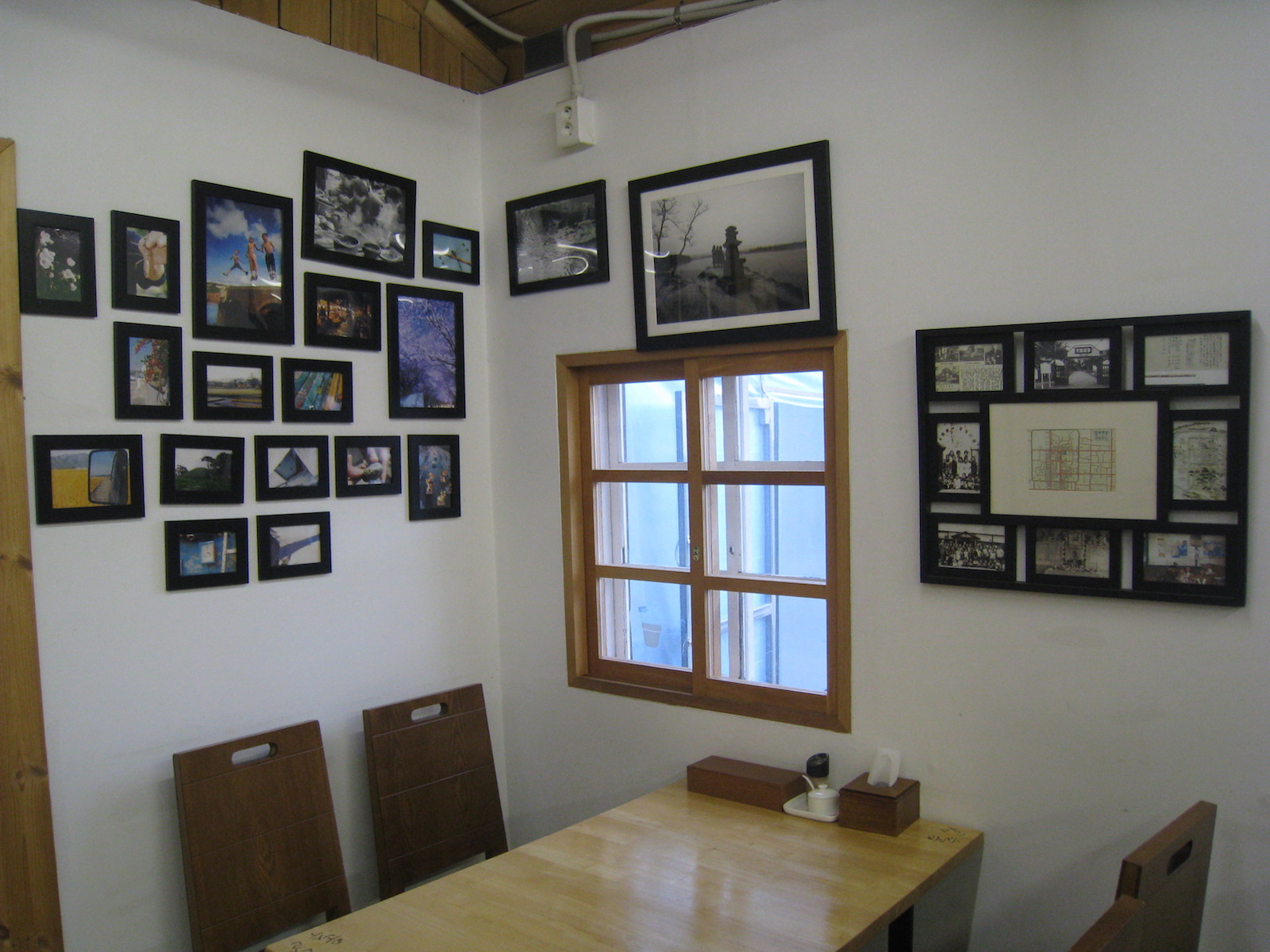
Inside the walls were decorated with all sorts of artistic photographs, ranging from landscape scenes to candid portraits.


But the pictures that struck our eyes were the 9 in the frame on the right of the above picture, shown again below:


These are all 20th-century scenes related to the Chinese-Korean school when it was in operation. On the lower right you can see a map of China on the classroom wall, and in the lower center photo are portraits of Sun Yat-sen and Chiang Kai-shek.

We didn't know anything about the place, but a young man—who turned out to be the owner—a little drunk from some lunchtime revelry with friends, wandered over to talk to us. "You are the first customers to ever notice these photos," he said. He sat down to tell us about them. He and Erma's mother chatted for a while about local history and his own history.

If you are a big-city person, Gyeongju isn't the place for you. But if you think you weren't meant for the modern era, consider opening a restaurant here and discovering a small circle of like-minded Bohemians.

Friday, June 26, 2015

Bicycles in Gyeongju

Gyeongju is a bike city. By that I don't mean that it is particularly friendly to bicycles. In fact, I'd be terrified to ride a bicycle here. But it seems that just about everyone rides a bicycle as a matter of course. It's a ubiquitous and unremarkable form of transportation.

In my American experience, people who ride bicycles are "marked" in some way. They do it for fitness, or recreation, or to make a point about the environment or about urban planning. It's hard to be a regular bike commuter in the US (which I am) without feeling like you're a bit iconoclastic. Certainly others will see you that way.

Not that there isn't recreational biking in Gyeongju. But that's mainly for tourists. Around the Bomun Lake resort area there are lots of bicycle rental shops. Korean and foreign tourists are among their patrons.

But it doesn't take long to realize that the vast majority of Gyeongju residents aren't biking for their health or for sport. Remember this picture of the riverside from an earlier post?


There is a dedicated pedestrian lane, in-line skate line, and bicycle lane. This is on a warm weekend afternoon in April. Where is everybody? (Answer: hiking.)

If you want to find all the cyclists, just walk on the city streets. Young and old, male and female, rain or shine, all on bikes.

First a whole lot of pictures (all taken on a two-block stretch near where we live), then some more commentary. You might notice some familiar faces on the margins of some of the pictures.


I find this intersection terrifying, whether I'm walking or driving. I would not want to bike through it.


A few things to notice:
  • No helmets. Never seen one.
  • Quite elderly, even frail people ride bikes.
  • This may resemble Holland in its flatness (ignoring the mountains ringing the city) and in the ordinariness of bicycle commuting, but it is certainly not Holland in terms of bicycle infrastructure. There is nothing in the way of protected or dedicated lanes or signals. Cyclists are pretty much always weaving in and out of traffic.
  • The masks are an ordinary thing in Korea (this has nothing to do with MERS). People wear them to keep out dust, as a courtesy if they have a cold, or if for whatever reason they are worried about getting sick. At all times of year it's normal to see people in face masks around the city.
  • Notice how many women are wearing enormous visors? This is what a lot of women, especially middle-aged women, wear for sun protection. (When hiking too.) Erma has been considering getting a visor on this trip, now that she too is an "ajumma".
  • The bikes are simple and practical, not built for speed or style. They are sturdy and most have baskets.
In a way, it seems a bit funny to point out how "amazing" it is that all kinds of people ride bikes here. Erma said to me, "It's like saying 'Look at how many different kinds of people drive cars in America. Young, middle aged, even seniors!"

Modified bicycles are not uncommon. Here's an adult bike with "training wheels", though whether it's because the rider has become too old to balance well, or whether it's because she never learned to ride a two-wheeler, is not clear.


Here is one of the bicycle racks in our apartment complex. Just about everybody seems to own a bike.


There aren't a lot of bicycle racks around town, but neither are they rare. Most are non-descript, but these swoopy colorful ones struck Erma's eye on a walk a few weeks ago:


Wednesday, June 3, 2015

Burial Mounds (part 2)

A reader of an earlier post on Silla royal burial mounds asks how they have remained intact, free from the depredations of tomb robbers and archeologists alike.

As it turns out, the earlier mounds are pretty much impregnable. The inner coffin chamber is surrounded by a gigantic pile of enormous rocks. I'm not sure the structure of the tombs was entirely understood until the 1973 excavation of Cheonmachong 천마총, the royal tomb in a downtown Gyeongju park that is open to visitors. (See the minimal Wikipedia entry for more info.) Here's a cross section:


It wasn't clear at first that there was anything valuable or interesting inside the tombs. Anyone who tried to get into one just found a giant pile of rocks.

During the Japanese occupation in the first half of the 20th century, the Japanese leveled a few of the tombs as a source of dirt for construction projects. Under the dirt they discovered the rock mounds and made some partial excavation efforts. They turned up a few non-descript objects within the upper layers of the rock mounds, and figured that was all there was. (Experts now think that these objects were placed as part of ritual ceremonies during various stages of completion of the tombs.)

It's clear now that the tombs are full of treasure. Check out this amazing gold crown that was found in Cheonmachong:


Cheonmachong, incidentally, means "Burial Mound of the Heavenly Horse". That's a name given by modern scholars after this painting found inside the tomb.


Even with the knowledge that treasure is inside, it wouldn't be easy for a tomb robber to get in. It would take weeks or months of work with heavy machinery -- not something you can do in secret. There's another major tomb excavation going on downtown right now, and it's taking a long time.

According to Erma's mother, who is very knowledgeable about local history and archeology, the later Silla tombs are quite different in structure. Their chambers can be accessed through a sort of hallway blocked off by a stone door. These are easier to penetrate and apparently some have been looted. On the other hand, in this later era it was no longer the practice to fill the chambers with treasure. By this time Buddhism had spread to Silla and been adopted by the elites; the Buddhist disdain for worldly pleasures had led to cultural shifts, including more modest burials even for royals.

Friday, May 29, 2015

Gyeongju's old city wall

The old city wall of Gyeongju, which dates back to the 11th century, has long fallen into disrepair, and its remains are only visible in a few places. But the city has recently embarked on an ambitious project to restore sections of it.
looking to the southwest: east section of wall and structure foundation
looking to the northwest: east section of wall and structure foundation (and boy with parasol)
Here's a bit of information about the city wall. Perhaps the stones visible in the pictures above are related to the Jipgyeongjeon Hall or the administration building mentioned in the text.

The word "defying" in the English text is definitely a mistake. The intended word is probably something like "displaying".

A bit to the north of where the two pictures above were taken is the location of the former east gate (Hyangilmun 향일문 向日門 'Facing-the-sun Gate') to the city. Several backhoes are currently at work day and night preparing the site for the restoration of the gate and surrounding wall, as well as a park-like adjoining area. It should be pretty spectacular when it's finished.

Artist's rendition of future appearance of this section of the wall
Gyeongju's been spending loads of money on these sorts of restoration projects, both beautifying the city and making it more attractive to tourists.

Another major project is the restoration of the old Woljeong 월정 Bridge. It was built in 760 and was Korea's first covered bridge. The restored bridge is going to be quite magnificent.

Artist's rendition of future appearance of restored Woljeong Bridge
Much of the bridge proper is already completed, but the two side houses are still under construction, so you can't yet walk across the bridge. We visited a few nights ago and discovered that the whole thing is beautifully lit up at night.


We hope to walk across it next time we have a chance to visit Gyeongju.

Friday, April 17, 2015

Drainage (may be more interesting than you think)

The sheer density of storm drains in our neighborhood streets is astonishing.


You can see three of them in the picture above. (That white building on the right is Tek's daycare.) You can also take note of how many there are in the nearby alley shown in this video.

They work pretty well when it rains hard. Underneath both sides of the street (what one might charitably call the "sidewalks") are basically just giant tunnels for flowing water.

So it's pretty baffling to me that so many residents and shop-keepers deliberately block up the storm drains in front of their buildings.


Three in a row are blocked in the above picture; it's the same street as in the first picture, just a bit farther down the block. All sorts of things are used to block the drains, including welcome mats and old carpet scraps, but the most popular object seems to be automobile floor mats.

The result is predictable.


I guess they want it this way. But why?

Update (April 19): Erma's mother says the drains are covered to block the unpleasant smells that emanate, especially in summer.

Wednesday, April 15, 2015

Burial mounds

Gyeongju, where we are staying, is the ancient capital of the Silla Kingdom, traditionally dated 57 BCE to 935 CE. During the Three Kingdoms period of Korean history, Silla shared the Korean peninsula with the kingdoms of Goguryeo and Baekje. With the help of Táng China, Silla conquered the other kingdoms in the 7th century and unified the peninsula in 668. From that point on what we think of as Korea has existed as a single state.

Although it is now a small city with a population under 300,000 and no downtown skyline to speak of, evidence of Gyeongju's glorious past is prominent throughout the city and its environs in the form of giant burial mounds (tumuli). According to Wikipedia, there are 155 tumuli in central Gyeongju, and 421 tumuli in the outskirts of the city. Nearly all are unmarked and unexcavated, so we don't know who is buried in them. But it's a fair bet that many Silla kings, queens, and nobles lie at rest within them.

Here are a few pictures of some of the burial mounds we've visited during our time here.


twin burial mound

Entrance tunnel to Cheonmachong 천마총, one of the few burial mounds that has been excavated. There is a small archeological museum inside displaying artifacts from the tomb.


This exceptionally large mound is one of the few with trees growing on it. It is situated in a downtown park. the yellow sign says "Please do not climb on the tumulus."
Three burial mounds at the base of (Mount) Namsan 남산 南山

Monday, April 13, 2015

Riverside run

Yesterday I ran along the river. The weather was perfect for outdoor exercise, mid 60s, slightly overcast. Since I haven't run for over four months, I took it easy, stopping to take pictures when something interesting took my fancy. I managed 4 miles.

It's only a few minutes from our apartment to the river. When I got there, I was surprised to find a bunch of ultimate frisbee games underway.


The players seemed to be mostly if not all foreigners. I heard a lot of American-accented English as I ran by. There were a few Asian faces, but of course impossible to know if they were locals or not. After my run I chatted with a few of the Americans. They told me that this was the opening weekend of the Korea ultimate frisbee league season, and that teams from cities all around the country competed in different locations each weekend. The man and woman I was talking to were expatriates living in Daejeon and Busan.

I started off running along the in-line skating pathway, since it seemed like the best option. The other paths were reserved for bicycles and, judging from the icon, strolling families. But after a while I reached some signs that definitively indicated I should be jogging on the path for walkers.

The green sign says "jogging and strolling path"; the blue sign says "in-line skating path".
It's astonishing how few people were out. Can you imagine Green Lake in Seattle being this empty on a spring Sunday morning at 11:30 am?

In total I saw two other joggers; a few power walkers (see above image); a handful of folks out walking their dogs; a fair number of cyclists, and one motorbike. (Technically motorbikes aren't allowed, but that doesn't seem to stop anybody.) There were stretches when nobody was in sight.

You shouldn't get the impression that Korean aren't into outdoor exercise. They are mad for mountain climbing. I'm sure all the locals trails in the surrounding hills were thick with hikers. (But that's a subject for another blog entry.)

This whole riverside pathway is only about 7 years old. It's a lovely city resource, if underused.

This map shows the area where fishing is forbidden. That also doesn't seem to stop anybody. In fact, the guys on the motorbike stopped to do some fishing.


At several locations along the trail are some very nice sets of exercise equipment.


Can you believe how empty this place is?
If you click through to the larger version of the photo above and squint, you can probably see the giant swastika on the building in the background. But I'll save you the trouble.

Bulguksa Munhwa Hoegwan 불국사문화회관
It's a Buddhist cultural center.

There was a poster along the side of the path for a rock climbing center. "Have you tried the Gyeongju 'Rock Climbing Center'??" it reads. It is of linguistic interest (to me).

The English word 'rock' is written . The English word 'climbing' is written keullaiming <클라이밍>. The English word 'center' is written senteo <센터>. I honestly have no idea if 'rock climbing' should be considered a Korean word or not.

These little-kid queens and kings are symbols of Gyeongju. They clearly belong to the category of excessively cute Olympic-type mascots. Perhaps they were created for some sort of international sports competition held here once.