Showing posts with label parking. Show all posts

Thursday, June 18, 2015

Wings (x2)

You can never have two many blog posts on parking, right? Right?

Koreans like big cars. But they have small streets and small parking spaces. That's probably why just about every car sold in the country folds up its side view mirrors when you lock the car.

To view higher-quality video on Vimeo, click me and enter password "korea".

And here's a follow-up to my earlier parking post on foam door guards: I now suspect that the whimsical wing-shaped door guards come from the dealer on every cute KIA Morning sold. I've been noticing them around town almost exclusively on this model of car.

A KIA Morning with pink wing-shaped door guards. Notice the side view mirrors are folded up.

Incidentally, the Morning seems to be one of the few cars on the road that comes in actual colors, instead of the typical black, white, and silver.

Wednesday, May 20, 2015

Parking in Gyeongju (part 4)

I mentioned in the first post of this series that the indiscriminate and inconsiderate parking habits are as much of a hassle for locals (at least when they aren't the ones doing the parking) as they are for visitors like me.

If you have a house or a business, how do you stop cars from parking in front, making it impossible for you to get in and out, move supplies in and out, and let customers in and out?

As you can see, a "NO PARKING - Tow Away Zone" sign will not do the job.
Small plastic traffic cones are no deterrent.  They can be easily crushed without damage to the car.


The most commonly employed solutions are low tech but quite effective. People set out obstacles, heavy and solid enough to deter a would-be parker from simply driving over them or moving them, but portable enough that they can be moved out of the way by the home/shop owner if necessary.

One of the most popular anti-parking devices are large plastic jugs filled with water or, more commonly, sand.


This residence is on our daily walk to daycare. Every morning the woman sets out her jugs on the street.


All sorts of other objects are employed. Giant tires, metal barriers.


Notice this metal thing is secured by a chain so it can't be stolen.

When not in use, it can be stored off the street. Note the wrappings around the sharp edges.
All of these barriers make it really hard to walk on the street as a pedestrian. Note that there are no sidewalks on these streets. When there are no barriers, you can walk reasonably safely just inside the dotted yellow lines, as here:


But when the barriers are out, you have to constantly step out into traffic in order to walk around them.

(This is post 4 out of 4 on the subject of parking. See earlier posts here, here, and here.)

Tuesday, May 19, 2015

Parking in Gyeongju (part 3)

As a rule, streets, driving lanes on major roads and freeways, and parking spaces are narrow. But Koreans have fallen in love with large cars. Fitting these cars into an infrastructure designed for small cars is a challenge; the likelihood of cars denting and scratching each other is high.

A very high percentage of cars have little foam blocks glued onto the doors. At first I thought that these were there to protect the car from getting damaged. But on reflection, that really wouldn't work: they can't keep the body safe from dents and scratches. It seems more likely that they are there to protect other cars from being dented by a thrown-open door. Or perhaps to protect the door edge itself from being damaged when thrown open into the side of another door.

Many of these foam blocks are blue and non-descript of shape.


At first I assumed that these were purchased by the car owner, but later I noticed the same kind of foam blocks on some new cars being transported by car trailer. So now I think they are probably put on at the factor to protect cars during transport to the dealer. I don't know if they are left on new cars when they are sold as a matter of course, or if the new owner can request not to have them removed.

Some foam door protectors come in other colors and inventive shapes, and I suspect that these have been purchased and attached by the car owner.

Here's a pink one shaped like ... hmm, maybe a cloud.


And here are pink ones that are wing-shaped.


And here's a car that appears to have supplemented the blue factory foam guard with some dog's-paw shaped foam pads that may be designed to protect the car from damage. Or perhaps they are just there to look cute.

By the way, if you look at the cars in my posts, you'll notice that nearly all the cars are white, black, or silver. It looks to me like well over 80% of the cars on the road are one of these three colors.

(This is post 3 out of 4 on the subject of parking. See earlier posts here and here and later post here.)

Saturday, May 16, 2015

Parking in Gyeongju (part 2)

Some people park in everyone's way so often that they keep their cell phone number visible on the dashboard. That way they can be reached and asked to move their car.

The methods for displaying the phone number range from the purely utilitarian to the whimsical.

"I am temporarily parked. Sorry!"


"Temporarily parked"

"Today too, safely ..."


I haven't bothered to blur out the phone numbers. Please don't call any of them!

I don't know if people put these numbers in the window out of a genuine desire not to be troublesome to others, or if they feel that putting their numbers in the window is a defense against ill will, giving them effective free rein to park wherever they wish.

(This is post 2 out of 4 on the subject of parking. See earlier post here and later posts here and here.)

Wednesday, May 13, 2015

Parking in Gyeongju (part 1)

In a continuing effort to make this blog as exciting as possible, I'm devoting yet another post to parking, everyone's favorite topic.*

Here's the first thing about parking. Parking spaces are fully enclosed by white lines, unlike in the US, where only three sides of the parking space are lined.

Note the burial mounds in the background. Sure sign that we are in Gyeongju.
It's amazing to me how such a small distinction can create such a large difference in impression. There's something about parking lots that seems Tetris-like, as if a child is going to arrange toy vehicles inside little rectangular compartments. Although the feel is very ordered, the effect is somewhat chaotic, as there is no indication of which side you are meant to enter the space from.

In Seoul and in Japan I've seen a lot of crazy parking structures that are designed to efficiently pack a lot of cars into very small spaces. I've blogged some of them; the photos are worth checking out.* We've only seen one such structure in Gyeongju, and it's not all that impressive. But it's still weird-looking to an American.

It's a parking elevator.
So here's my rant. I really, really, really hate the way people park here. It is careless, thoughtless, and hazardous. There seems to be no limit to how illegally or dangerously someone will park. Completely blocking traffic, putting pedestrian lives in danger, causing material damage to public and private property—these are apparently not concepts that trouble the minds of drivers wishing to leave their cars.

I'm pretty tolerant when it comes to cultural differences. But not in this case. I feel constantly endangered by the idiocy of the parking culture here. Below is my gallery of annoyingly, stupidly parked cars. You could get this many pictures any day of the week by walking around for five minutes. I am mercifully only posting seven here for now.

Car blocking alley

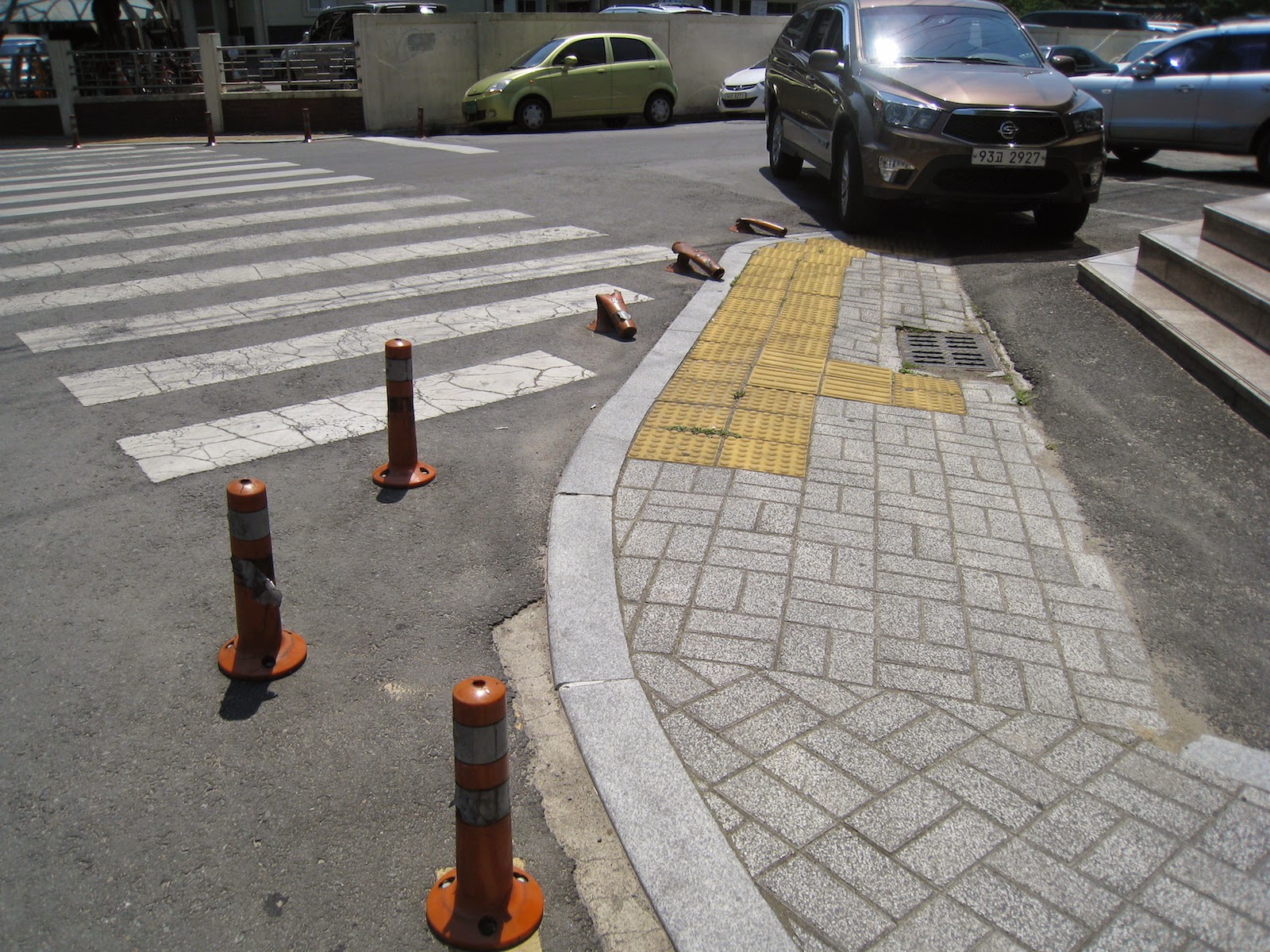
Close-up of hopelessly inadequate cones meant to prevent cars from parking in crosswalk

Car in crosswalk

Car even more blocking crosswalk, and sidewalk

Cars parked on sidewalk

Car parked in front of "No parking in road" sign

Car making mockery of rubber cone
 When I asked Erma's parents why Koreans do this, my father-in-law's response was "Those stupid guys." I guess that's about all the explanation one can hope for.

  Needless to say, there is no parking enforcement. Maybe a few tickets would solve the problem.

  This situation is not just painful to foreign visitors, but also creates a great deal of inconvenience for locals (when they are not themselves being drivers). I'll post about how they deal with the parking nightmare soon.


* Okay, maybe just my favorite topic. Here are all the posts on this blog that have been tagged with the label "parking" -- 8 and counting.

Monday, January 26, 2015

We're back, baby!

I am back in Korea, in quite different circumstances from my last major sojourn in 2007-08. So time to revive the blog!

One thing is identical to before: I am on sabbatical. In fact, I am embarrassed to say that I am working on the same damn research project as last time I stayed in Korea, a project I should have finished years ago.

But many things are different: I am here not only with Erma, but also with Tek, our little 3-year-old boy. We are in Gyeongju 경주 慶州, not Seoul, and living with Erma's parents in their large, comfortable apartment. We have put Tek into Korean daycare. Erma and I have rented a studio apartment which we are using as a daytime office.

We have now been here for three weeks, just enough time for the contours of our daily routine to start to resolve. Perhaps the most gratifying thing to date has been how resiliently Tek has dealt with being completely uprooted and thrown into unfamiliar circumstances, and how game he has been for new adventures, new foods, and new experiences. The only truly difficult thing for him has been adjusting to his new daycare and the communication barrier, but over the last few days he has apparently found his footing there as well.

One of the great things about our set-up is that the three places that triangulate our lives—home, daycare, office—are within a five minute walk. In fact, our office is located right behind the daycare.

Our office is in Herren Haus. Don't ask my why it's called that, I don't know.
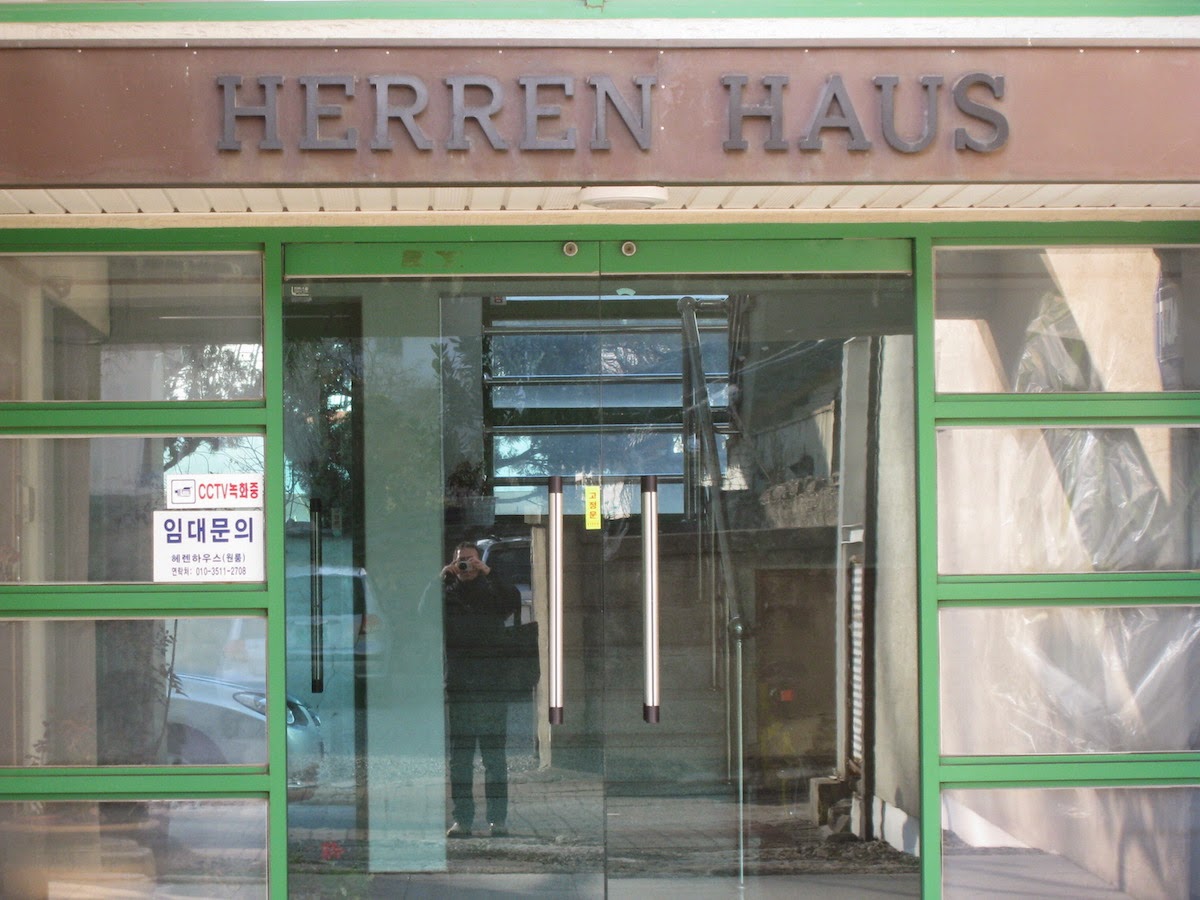
House of Lords!

As I mentioned earlier, our "office" is really a studio apartment. I wouldn't want to live here, but it makes for a pretty great office.

Check out the funky-shaped little windows.


We get to Herren Haus via a small alley right next to Tek's daycare. This is the view of the daycare from just outside the front door of Herren Haus.


The small alley is a functioning street, open to motor vehicle traffic. That doesn't stop people from parking there.


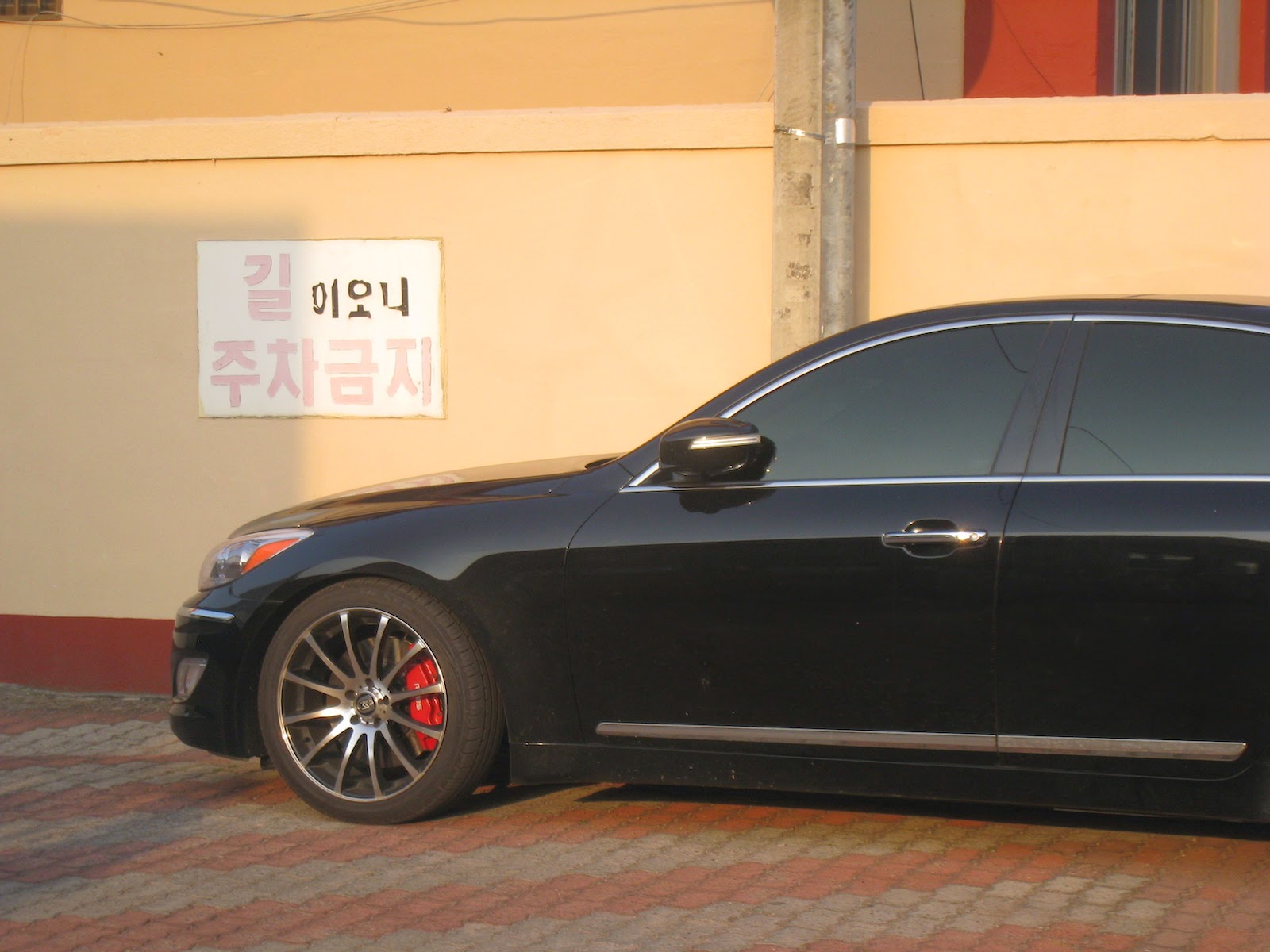
The "Since this is a STREET, NO PARKING" sign doesn't seem to be doing any good.


This behavior is entirely consistent with Korean driving culture. It has been an interesting exercise in moral philosophy trying to explain to our boy why every single car in the country is illegally (and dangerously) parked.

The only thing that is less than ideal about our situation is that the five-minute walk to school with the boy is incredibly terrifying. After we leave our apartment complex we only walk along two little streets for half a block each. But it is terrifying.

There are no sidewalks. The edge of the street, a three-foot wide strip demarcated by a dotted yellow line, which is supposed to be safe to walk on, is obstructed or cluttered by trash, rocks, detritus, glass, cement outcroppings, poles, and homemade "no parking" obstacles. None of this prevents cars from parking, reducing the two-lane road effectively to a one-lane road, through which cars speed with abandon despite the high density of pedestrians and cyclists. This is all normal to the local residents, but strikes fear in my parental heart.

Here are a few photos of the two streets we have to navigate. Erma and Tek are in a few of them.

Will you look at this thing is blocking the "sidewalk"?

These plastic jugs weighted down with sand have been set out to prevent cars from parking here. They also prevent pedestrians from walking by.
Notice the tow-away zone sign on the pole in the foreground!

Guess we'll have to go out into the street again.

Careful, Tek and Erma!


By the way, in case it isn't apparent, I love it here.


Wednesday, July 21, 2010

Parking

My idiosyncratic travel obsessions are all on display in this blog: food, language, transportation, vending machines, and parking, as exemplified by the excessive number of posts I've made in the past on these subjects.

There's plenty of interest to say about parking in Japan.  It seems that it's not just me who is obsessed with parking; sometimes I feel that the whole country is obsessed with parking.  In Matsuyama, pay parking lots are everywhere.  You have to get pretty far out from the city center to find free parking.
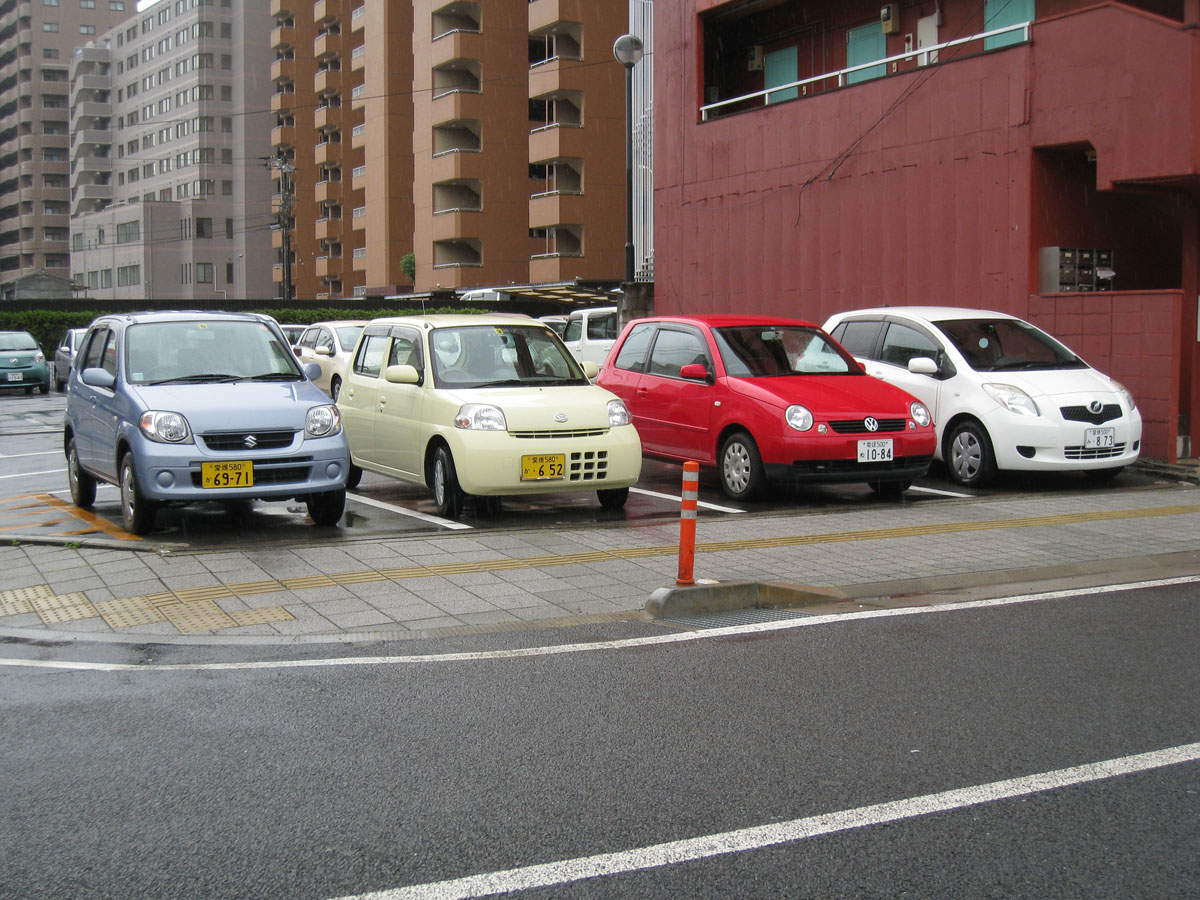

Aren't those little Japanese cars cute?  You'll notice there are two colors of license plate: white and yellow.  Cars below a certain weight have yellow license plates; I'm told that there is a tax break for purchasing such cars.  My Japanese host told me that you can compare the relative wealth of different parts of Japan by looking at the percentage of yellow license plates, and you can also chart the continuing economic difficulties in the country by observing the ratio of yellow plates increase over time.

Usually the cars with white license plates are bigger, but occasionally you see small heavy cars (like Mini Coopers) with white plates, and big light cars (Japanese SUVs that seem to be made of plastic) with yellow plates.

Quite a few of the small, new Japanese cars look like throwbacks to little British 60s numbers, like the white car on the left in the picture below.  I'm quite fond of those.


Many of the pay parking lots have mechanisms in each space that appear to be designed to prevent cars from moving.


Here's a close-up of one in the engaged position:


I never did figure out how these work.  Do they come up automatically after you've parked, and not retract until you pay the full amount owed?  Or does the car owner voluntarily engage them to discourage theft?

Here's a different design:


And here, just for fun, is a Mini Cooper, a car lock mechanism, and a stray cat:


Because space is at a premium in Japan, there are many mechanisms for squeezing cars into small spaces.  Some are quite elaborate, and while there is some overall similarity to some of the parking structures I saw in Seoul, there are quite a few differences in detail.

Here are some cars stacked up in layers:


I really like that last picture, it puts me in mind of an Olympic medal ceremony.

More intriguing to me than the lots are the parking towers, which seem impossibly narrow.  This picture was taken from Osaka's Tsūtenkaku Tower:


I wish I could see inside these things to understand how the cars are distributed.  This is the parking tower in the tourist section of Matsuyama:


There are two entrances, each of which is a car elevator.  What happens to the car after it reaches its destination floor?  Does it drive forward?  (The driver does not go up with the car.)  Is it shunted off to the side?  It's hard to see how more than two cars can fit in each level, given that much of the interior space must be taken up by the elevator shafts and counterweights.


Here's a video of a car getting whisked up into the tower.


Many parking structures are even more elaborate than the simple elevators. After many weeks, I finally managed to get some video footage of them in the last days of my stay in Japan. I hope you enjoy these as much as I do.


The above two videos are of commercial parking structures.  This one is residential: