
Showing posts with label construction. Show all posts
Showing posts with label construction. Show all posts
Friday, June 19, 2015
Thatched roofs
In the old days, the roofs of traditional Korean houses were thatched with straw. You don't see many thatched roofs these days, but we spotted one today downtown, tucked between some modern buildings.


Monday, June 8, 2015
What happened to the piano store?
When we moved here in January, there was a piano store two storefronts away from Tek's daycare building. It's one of many sites within a few blocks of where we live that has gone under construction in the short time we've been here. It seems that the store has been converted to a combination living quarters and, bizarrely, branch office of the Korea JoongAng Daily newspaper.
It's been pretty interesting watching the construction methods (and the way it all spills out into the narrow street, blocking traffic and creating various safety hazards). Sadly, the nicely paved golmok 골목 (alley) running alongside the store and leading to our office suffered a bit as a result of the construction. The paving stones were pulled up to install underground pipes, and were reset quite poorly. (You can see video of how nice the alley used to look on this post.)
After gutting the inside and removing most of the outside walls, new walls were built of roughly set bricks (right) and then mudded over (left).

One reason they had to make new walls was that the old piano store had a giant doorway, large enough for pianos to fit through. They wanted a normal narrow doorway (center):

Note also the pile of dirt right in the middle of a narrow street.
Here's a mini excavator digging up the paving stones in our alley, next to the store (which is on the left in this photo). Note the old blue tile roof.

I don't know exactly what this layer is, or why it is scored in squares.

After that, styrofoam boards were glued and then screwed onto the building, and then painted over with bumpy fake stucco. By the way, that little door leads to a squat toilet accessible only from the outside. The door is raised because the bathroom floor is raised; that's typically done so that the toilet can be set into the floor.

This seemed really weird to me, but an architect reader of this blog pointed out that this is a known construction technique, also used in dry climates in the States like Southern California. ("Styrofoam under fake stucco is called Dryvit (manufacturer) or STO (manufacturer) or EIFS (exterior insulation and finish system).")
In this photo you can clearly see the styrofoam under the stucco finish:

Then they built this elaborate framework on the roof. At first I got excited, thinking that they were going to install solar panels.

But it turned out that they were just building a new roof atop the old one. Guess that's easier than repairing or replacing.

And here's the near-finished look of the new place.

The sign is up, and nice copper gutters and downspouts. And some steps and a ramp blocking the sidewalk.
This is apparently a neighborhood newspaper distribution center, and possibly a small office for accepting local ads.
It's been pretty interesting watching the construction methods (and the way it all spills out into the narrow street, blocking traffic and creating various safety hazards). Sadly, the nicely paved golmok 골목 (alley) running alongside the store and leading to our office suffered a bit as a result of the construction. The paving stones were pulled up to install underground pipes, and were reset quite poorly. (You can see video of how nice the alley used to look on this post.)
After gutting the inside and removing most of the outside walls, new walls were built of roughly set bricks (right) and then mudded over (left).

One reason they had to make new walls was that the old piano store had a giant doorway, large enough for pianos to fit through. They wanted a normal narrow doorway (center):

Note also the pile of dirt right in the middle of a narrow street.
Here's a mini excavator digging up the paving stones in our alley, next to the store (which is on the left in this photo). Note the old blue tile roof.

I don't know exactly what this layer is, or why it is scored in squares.

After that, styrofoam boards were glued and then screwed onto the building, and then painted over with bumpy fake stucco. By the way, that little door leads to a squat toilet accessible only from the outside. The door is raised because the bathroom floor is raised; that's typically done so that the toilet can be set into the floor.

This seemed really weird to me, but an architect reader of this blog pointed out that this is a known construction technique, also used in dry climates in the States like Southern California. ("Styrofoam under fake stucco is called Dryvit (manufacturer) or STO (manufacturer) or EIFS (exterior insulation and finish system).")
In this photo you can clearly see the styrofoam under the stucco finish:

Then they built this elaborate framework on the roof. At first I got excited, thinking that they were going to install solar panels.

But it turned out that they were just building a new roof atop the old one. Guess that's easier than repairing or replacing.

And here's the near-finished look of the new place.

The sign is up, and nice copper gutters and downspouts. And some steps and a ramp blocking the sidewalk.
 |
| Sign reads: 중앙일보 (JoongAng Daily) |
Friday, May 29, 2015
Gyeongju's old city wall
The old city wall of Gyeongju, which dates back to the 11th century, has long fallen into disrepair, and its remains are only visible in a few places. But the city has recently embarked on an ambitious project to restore sections of it.
Here's a bit of information about the city wall. Perhaps the stones visible in the pictures above are related to the Jipgyeongjeon Hall or the administration building mentioned in the text.
A bit to the north of where the two pictures above were taken is the location of the
former east gate (Hyangilmun 향일문 向日門 'Facing-the-sun Gate') to the city.
Several backhoes are currently at work day and night preparing the site for the
restoration of the gate and surrounding wall, as well as a park-like adjoining area. It should be pretty spectacular when it's finished.
Gyeongju's been spending loads of money on these sorts of restoration projects, both beautifying the city and making it more attractive to tourists.
Another major project is the restoration of the old Woljeong 월정 Bridge. It was built in 760 and was Korea's first covered bridge. The restored bridge is going to be quite magnificent.
Much of the bridge proper is already completed, but the two side houses are still under construction, so you can't yet walk across the bridge. We visited a few nights ago and discovered that the whole thing is beautifully lit up at night.

We hope to walk across it next time we have a chance to visit Gyeongju.
 |
| looking to the southwest: east section of wall and structure foundation |
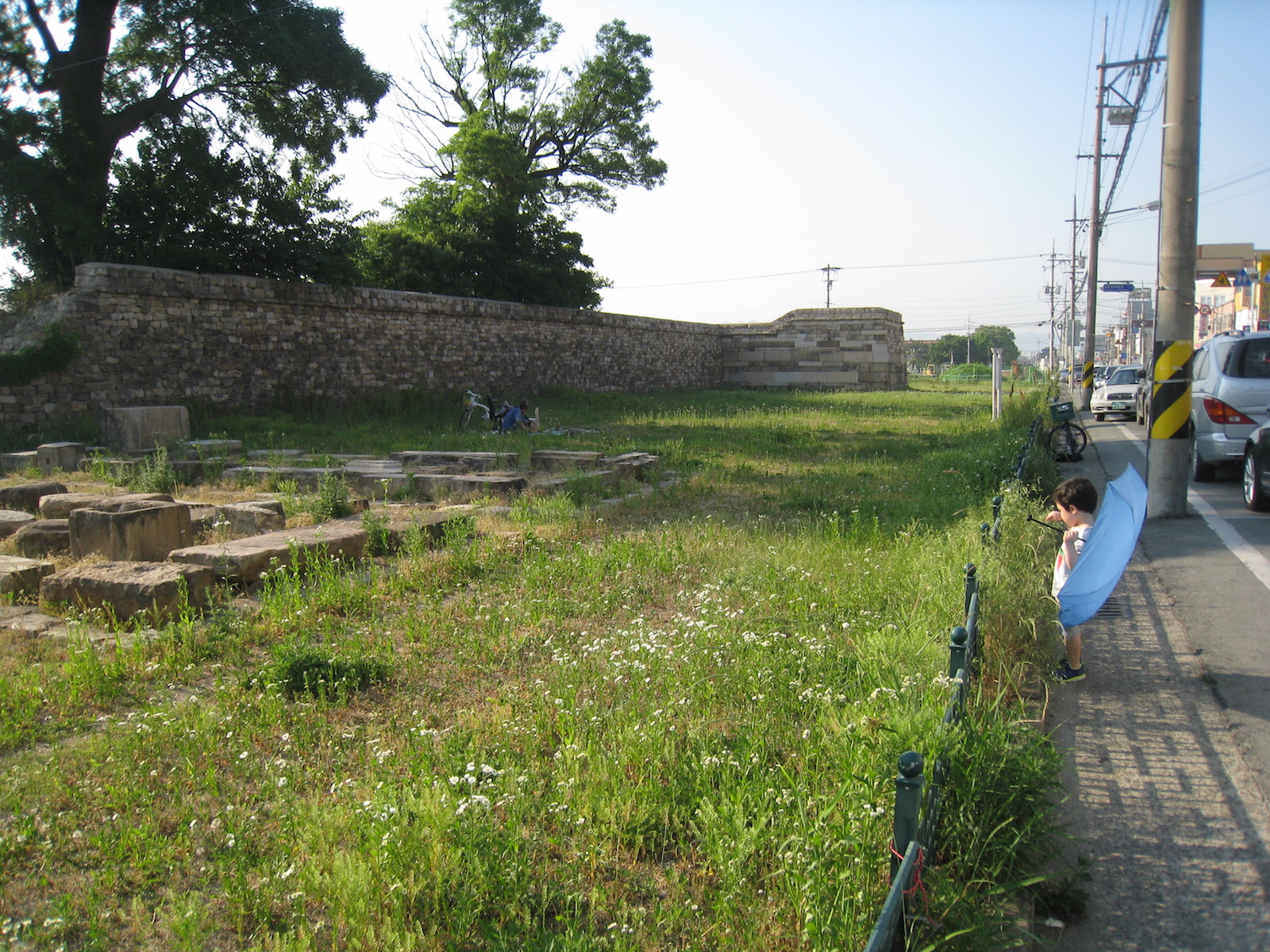 |
| looking to the northwest: east section of wall and structure foundation (and boy with parasol) |
 |
| The word "defying" in the English text is definitely a mistake. The intended word is probably something like "displaying". |
 |
| Artist's rendition of future appearance of this section of the wall |
Another major project is the restoration of the old Woljeong 월정 Bridge. It was built in 760 and was Korea's first covered bridge. The restored bridge is going to be quite magnificent.
 |
| Artist's rendition of future appearance of restored Woljeong Bridge |

We hope to walk across it next time we have a chance to visit Gyeongju.
Tuesday, April 7, 2015
Everything old is new again
We've only been living here for three months, and already we've seen an enormous amount of turnover of the businesses along the few blocks we walk every day. What impresses is not just the number of stores and buildings we've seen demolished and rebuilt, but the speed at which it happens.
This dog-soup restaurant that I photographed two months ago:
has just been replaced with this dog-soup restaurant:
Those are grand opening decorations flanking the doorway.
The coffee shop next door to Tek's daycare was transformed into a hoe 회 (Korean sashimi) restaurant in a matter of days. Now the piano shop next to that restaurant is being demolished.


There are not the same kind of safety precautions here as in the States, for either workers or bystanders. One seldom sees construction workers with safety gear like helmets, ear protection, or goggles even when they are operating heavy, loud, dangerous equipment. The work often spills out into the street without regard for impact on traffic or pedestrians.
A block east of Tek's daycare a new building is going up. One day on our way home we stopped to watch a mini excavator digging a trench in the road in front, presumably for some kind of utility hook-up. Notice the total lack of signs, cones, or any accommodation for the two-way traffic and the pedestrians.
Cars just squeezed by as best they could.

Two months ago I took a picture this storefront because something about the sign amused me (I don't even remember now what it was). It's a skin care place (there are a lot of these around).

It then closed, and we've been observing its transformation into a restaurant. Bringing Tek by after daycare to check on its progress has become part of our daily routine. The other day we overheard the restaurant owner, who is often on site supervising, refer to Tek as her "regular customer kid" on the phone.
They just got their new signs up today. But they haven't completely removed the old signage yet.

I don't know if all this demolition and construction and business turnover is just the way things always are here, or if the economy is entering a boom phase.
This dog-soup restaurant that I photographed two months ago:
 |
| Yeongyang tang 영양탕, literally "nourishment soup", refers to soup made from dog meat. |
 |
| Bosin tang 보신탕, literally "rejuvenating soup", also refers to soup made from dog meat. |
The coffee shop next door to Tek's daycare was transformed into a hoe 회 (Korean sashimi) restaurant in a matter of days. Now the piano shop next to that restaurant is being demolished.
There are not the same kind of safety precautions here as in the States, for either workers or bystanders. One seldom sees construction workers with safety gear like helmets, ear protection, or goggles even when they are operating heavy, loud, dangerous equipment. The work often spills out into the street without regard for impact on traffic or pedestrians.
A block east of Tek's daycare a new building is going up. One day on our way home we stopped to watch a mini excavator digging a trench in the road in front, presumably for some kind of utility hook-up. Notice the total lack of signs, cones, or any accommodation for the two-way traffic and the pedestrians.
 |
| This is an active two-way street! |
 |
| Occasionally this guy with a broom would step out into the street to make sure the cars didn't fall into the trench. |
It then closed, and we've been observing its transformation into a restaurant. Bringing Tek by after daycare to check on its progress has become part of our daily routine. The other day we overheard the restaurant owner, who is often on site supervising, refer to Tek as her "regular customer kid" on the phone.
They just got their new signs up today. But they haven't completely removed the old signage yet.
I don't know if all this demolition and construction and business turnover is just the way things always are here, or if the economy is entering a boom phase.
Subscribe to:
Posts (Atom)