Showing posts with label election. Show all posts

Thursday, July 8, 2010

Election

As some of you may know, Japanese parliamentary elections are coming up July 11.  The Democratic Party has been in office only 10 months or so in a country where the more conservative Liberal Democratic Party has completely dominated politics since the end of World War II.  And the current Prime Minister, Kan Naoto (Kan being one of the shorter Japanese family names you'll come across), has been in office for even less time, since his predecessor resigned about a month ago over issues related to American military bases in Okinawa.  I gather Kan's government has been reasonably popular.  But the economy here is still moribund -- it has been for over a decade -- and Kan has just proposed raising taxes to cut down the federal deficit.  So it'll be interesting to see what happens.

This sign appeared on the street near my guesthouse a few weeks ago.


It's clear that each candidate is assigned a specific numbered slot on these signs.  These signs are up all over the city, and on each sign a given candidate's poster always appears in the same numbered slot.  I've seen a few other individual candidates' posters stuck up around town, but I'm not sure if they are legal.  It's possible that the sign pictured above is the only way you are allowed to advertise.  (Maybe a reader out there knows?)

In Yokohama, there are more candidates running, so the posters look like this:


Now, where have I seen something like this before?  Oh, yeah, I remember: in Korea in 2007 before the presidential election.  Here's what those posters looked like:


In Tokyo it was an audio nightmare.  I mentioned before that Japan is in the yelling-at-you-to-sell-you-something part of the world.  It's also in the yelling-at-you-to-get-your-vote part of the world.  Probably these two parts of the world largely overlap.

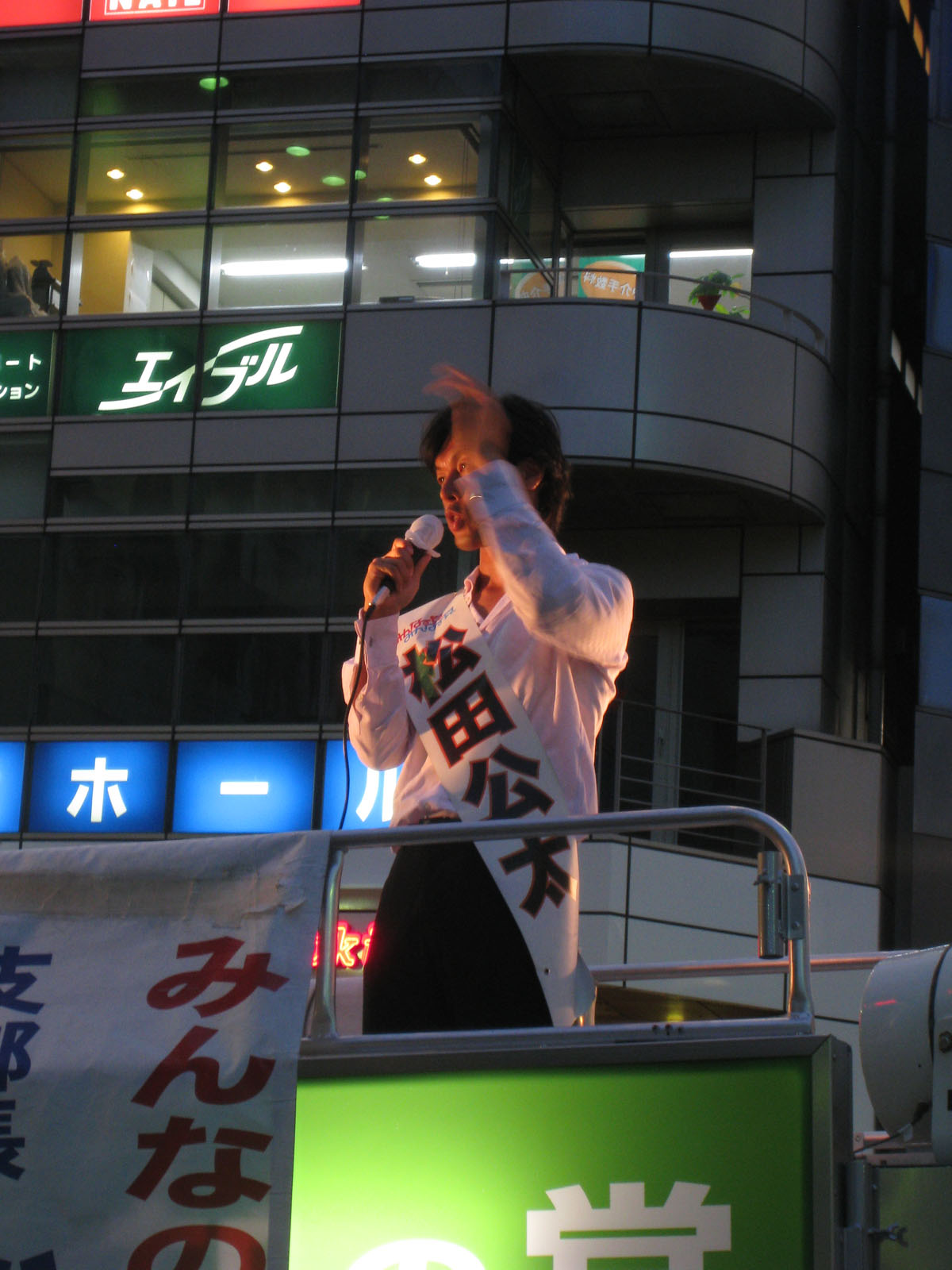
At busy intersections, vans would park and spew campaign messages out through high-powered megaphones.  These volume was set far too loud, and I quite literally feared for my hearing when I walked by them, fingers pressed over my ears.  Sometimes candidates or their representatives would come out and give speeches atop the vans, their words equally heavily amplified.  This is in Shibuya (Tokyo), a few days ago:


Lessee, where have I seen campaign workers wearing sashes like that before?  Oh, yeah, I remember: in Korea in 2007 on the day of the presidential election.  There really are a lot of little cultural overlaps between Japan and Korea.

Anyway, these stupid megaphone trucks would drive up and down the streets at all hours of the day and night.  Even up in my 7th-floor hotel room, with the windows and curtains firmly closed, it was loud enough to make me wonder if I'd have trouble falling asleep.

As it turns out, I'm not the only one bothered by this particularly noiseful way of conducting election campaigns.  I just came across this Washington Post article specifically on this topic.  Apparently candidates are barred by law from using other means (like knocking on doors or sending tweets) to carry out their campaigning.

Saturday, April 12, 2008

Seongeo 2

A quick update on election results. President Lee Myung-Bak's party, the conservative Grand National Party (한 나라당), did not do as well as originally expected, but did manage to capture a slim majority in the legislature, with 153 seats out of 299. (I think these might be the guys in blue in my previous post, but I'm not sure.) The former majority party, the United Democratic Party (통합민주당), suffered serious losses.

Given his slim parliamentary majority, Lee Myung-Bak will probably be able to implement a good chunk of his domestic program, which includes business-friendly policies to help promote economic growth. He's also expected to take a harder line with North Korea than the previous more liberal administrations.

Turnout in this election was extremely low; there's been a lot of discussion of the reasons for such voter apathy, especially since the turnout was pretty high for the presidential election last winter, and there is widespread anxiety about the economic situation here.

The low turnout was despite the fact that the government was giving away vouchers for government-run museums and parks worth 2,000 won (about US $2) to anyone who voted!

(Sorry, no pictures this time!)
(By the way, this is Post #100!)

Wednesday, April 9, 2008

Seongeo

Today, April 9, was election day. As such it was a legal holiday. We had no classes and most businesses were closed.

Over the last two weeks there has been a lot of visible campaigning around Seoul. Campaigners are easy to spot because they wear colored uniforms with sashes. I don't know if this is by custom or if there is some sort of legal requirement.

On March 31 I took some photos of campaigners on my little street.


This van for Candidate #1, Yu Gihong, parked at the corner (by the kids' stationery store).


Then these two men, one in a dark suit and one in a green campaigning uniform, got out of the van and walked into each shop on the block, presumably to talk to the shop owners and seek their votes. The guy in the suit seemed to be a handler. So I wonder if the guy in the uniform was the candidate himself.


They are going into the little tteok specialty shop next to my dorm.

Every morning there have been campaigners outside the busiest subway station entrances. They are invariably in groups of two to four, periodically chanting slogans in unison while making some sort of coordinated arm motion, and then bowing. It's not clear to me if this would sway anyone's vote, but it does get my attention.

I tried yesterday, the day before the election, to film this so you could see what it looks like. I was a bit hampered because I was trying to be inconspicuous and I was using only one hand.


Sorry about my finger blocking the lower right corner of the screen!

The greens were out in force -- occupying two sides of the sidewalk and working in unison. The blues, standing closer to the subway entrance, looked a bit demoralized by comparison.

Watching the movie now, I've just realized that the greens are chanting something like "Il-beon Yu Gihong-imnida 일번 유기홍입니다" -- "It's #1, Yu Gihong!". (Can someone verify this for me?)

Today there was no campaigning -- it must be illegal on the day of the election. I, like almost everyone else in Seoul, took advantage of the holiday to go hiking in the mountains.

Sunday, March 30, 2008

Changdeokgung

Today was the first weekend since I arrived that afforded me some free time. I decided to spend today (Sunday) doing some sightseeing and looking for books downtown.

I ended up taking a tour of Changdeok Palace (창덕궁 昌德宮). It's just to the east of Gyeongbokgung, which Erma and I visited last autumn on Chuseok. Although it was not the main palace of the Joseon Dynasty, it served as the principle residence and administrative center of the government after Gyeongbokgung was burned down by the Japanese in the late 16th century. The palace dates to the early 15th century but many of the individual buildings suffered fire damage at various points in history and were later reconstructed.

In order to help preserve Changdeokgung, it is not permitted to tour the grounds without taking part in a guided tour. Luckily I arrived just 10 minutes before the early afternoon English-language tour was about to start.

This is the main entrance gate of the palace grounds.

The grounds are extensive and pleasant, and because of the guided tour policy, mostly empty.


This is our tour guide.


This striking building is Injeongjeon 인정전, the main hall used for ceremonial purposes. It's the tallest and most impressive-looking building in the palace.


These stone markers indicate the positions where the different ranks of officials were to stand during court ceremonies.


Inside is the king's throne. The electric lights were installed in the first decade of the 20th century.


Behind the throne is a painting of the moon and the sun (representing the yin and yang principles, and thus the queen and king) and five mountains (representing the five elements of yin-yang theory).


I took some photos of the exquisite painted exterior decorations and carved tiles of some nearby buildings.


I really liked this little doorway, too.


This is the interior of the building that served as the king's office during the last years of the dynasty. There is some French-style furniture.


This is the queen's bedroom. She's got dragon-headed posts at the foot of her bed.


Out in front of the royal sleeping quarters is this little sundial. I was fascinated by it.


Around the outer edge the 24 directions (and probably also representing 24 hours of the day) are marked using the traditional Chinese system, and the characters are all in the ancient seal-script style. (On the system, see the last section on "Directions" in this Wikipedia article). The 24 seasons of the traditional Chinese agricultural calendar are marked on the rim as well, presumably because the time could only be read properly from the sun's shadow by calibrating with the time of year.


It's a bit hard to see because of the bright sun. I've darkened the image and increased the contrast in this close-up:


Along the top of the rim are some more characters written in the old seal-script style. The first two on the right read 漢陽 (한양 Hanyang), one of the old names for Seoul. (Han is the name of the river that runs through present-day Seoul. The old city was built on the north bank. In Chinese the north bank of a river is referred to as the yang side, yang being the the member of the yin-yang pair representing the male principle, light and warmth. This is because the north bank of a river is warmed by the sun, which is in the south part of the sky.)


You can see these two characters more clearly here (remember, they read from right to left):


After the death of the last Joseon king during the Japanese occupation, the queen moved into this smaller residence on the palace grounds. She lived until the 1960s. Apparently members of the royal family lived here until as late as 1989. After that ownership reverted to the government.


There were some really nice old pine or juniper trees nearby.


This is the way ondol (floor-heating) worked before modern times. Fires were lit in holes like this under the buildings, and the heat circulated through a network of stone corridors under the floors.


A system of chimneys like this one vented the smoke.


Spring was in evidence around the grounds, even though it was a chill gray day.


In the back of the palace grounds is the famous "Secret Garden", a favorite spot of the Joseon kings for quiet contemplation.


This building in the Secret Garden, the Juhap Pavilion (주합류 宙合樓) is the original home of the Kyujanggak royal library.


After the tour ended I walked from the palace to the Kyobo Bookstore. I saw a lot of interesting things on the way.

These first two pictures might only be of interest to Erma. This is where we ate kabobs when we visited Gyeongbokgung on Chuseok. The little Kkio Kabob place is gone.

Apparently replaced by a "Children's Historical Culture School".


I saw an election rally. The presidential election was held last fall, but legislative elections are coming up soon. It seems like a bad idea to have these two sets of elections a few months apart instead of at the same time. If the president elected in the fall, Lee Myung-Bak, is going to be able to put his program into effect, he needs a majority in the legislature. But the mood of the electorate might have changed since he reached office.


I also liked this giant election poster, in part because I could understand everything written on it. "Next Generation Leader!" "The Era of Citizens' Success!" The candidate's name is Bak (commonly spelled Park in English) Jin.


Then I saw this colorful motorcycle gang.


Here's what Gwanghwamun looks like now. You can compare it with these pictures I took last December.


This is the American embassy, which is under heavy security at all times. Those are riot police vans lined up beside it. You can also see Korean guards on the left side of the frame.


This is a mystery shot. Can you identify this sculpture?


That's right, it's Hammering Man, photographed from directly below!


This is a sign in the food court of Kyobo Books.


The spelling reminded me of a very old, classic joke. (If you don't know it, I'll be happy to tell you. Post a comment.)


On the subway ride home, I really enjoyed this sign, which says that inappropriate physical contact makes everyone uncomfortable. On the right side we see a couple making out while the guy next to them fumes. On the left side, a man is groping an unwitting female passenger's butt, making a third passenger uncomfortable. What I find amusing about the picture on the left is the suave look of utter nonchalance on the man's face.


In four small circles at the bottom of the ad, additional behaviors are sanctioned. They are: drinking from a cup, selling things, reading a newspaper without folding it in half, and spreading your legs wide when you sit.


I got off two subway stops from home, at Sadang 사당, walking a section of town I hadn't seen before. I thought this building was interestingly named. It's the Dat Keom Officetel. That's the Korean rendering of ".com".

Thursday, December 20, 2007

Cheonggyecheon

As Erma mentioned, one of the things that Korea's new president-elect, Lee Myung-bak, was known for when he was mayor of Seoul was daylighting Cheonggyecheon 청계천 (淸溪川), the stream that runs through the center of Seoul.

This is what the stream looked like in 1903:


By the 1950s, the area had become an eyesore and a health hazard. Squatters' shacks crowded the shores, and local residents used the stream for bathing, laundry, and sewage. In an attempt to clean up the area and modernize the city, the government paved over the stream. Some years later an elevated highway was built above it.

In 2003 Lee Myung-bak initiated a project to uncover, or "daylight", the stream, turning it into a public recreational area and providing a respite from the concrete and steel that dominate the city. The project was completed in 2005. Now it looks like this:


(The picture was taken when we visited in mid-October, before the weather turned cold.)

Underneath one of the overpasses of the stream is a small historical museum displaying photographs of the area dating back to the turn of the century.

History goes in cycles. When the stream was covered over it was viewed as an improvement to the city. Now the stream is uncovered as an improvement to the city.

Wednesday, December 19, 2007

Election coverage

It's a little unfair for me to write about election coverage, because we turned on the TV only half an hour before a winner was declared. Still, that was enough time for us to see some amusing coverage, including this depiction of the election as a marathon. Here's Lee Myung-bak running way in the lead, passing the signpost for Gangwon Province.


And here's the cluster of candidates at the back of the pack.


Just after the winner was declared, Lee is shown winning the race. At his feet you can see the tape that he has just broken through.


Finally, here are the two announcers who had been narrating the marathon. One of them has a Lee face on and is apparently imitating his speech style. Seems kind of low budget compared to the marathon.  You'd think they could have made Lee's head more life-sized.  


I'm looking forward to seeing something similar on CNN next year.