Wednesday, May 7, 2008

Jjukkumi

My time in Korea is rapidly drawing to a close. I return to America in less than two weeks.

Today was the first part of my final exam, listening and speaking. Tomorrow we will have the writing and reading sections, and then Friday is our "completion ceremony" (수료식 修了式). After that there are no more classes, and I'll spend time visiting people and packing.

The SNU semester continues -- it is on a different schedule from the language school -- but today was also the last day for me to attend the Korean philology seminar that I've been sitting in on. As we do after most class meetings, the students and I had dinner at the dining hall with the professor today. As it happens, one of the two dishes being served was jjukkumi 쭈꾸미, baby octopus, which I discussed in this post.

They are pretty tasty, decapitated and fried in hot sauce with onions and served over rice.

I'm not sure I could handle eating a live one, though.

Sunday, May 4, 2008

Gyotong Anjeon

Last fall I posted a few entries on traffic and parking.
I've become a lot more accustomed to dealing with Korean drivers as a pedestrian. The first key insight was the realization that both drivers and pedestrians tolerate a much higher degree of proximity between motor vehicle and human body than they do in the US.

Before, I thought that a driver backing straight into me either didn't see me, or was planning to run me over. Now I realize that the driver HAS seen me; s/he is still backing up because the car is still more than a foot away from me. Similarly, a driver turning into the street as I'm crossing it isn't planning to hit me; s/he is planning to miss me by six inches.

The second realization is that there is no such thing as right of way. Whoever, driver or pedestrian, gets into the path of the other first gets to go.

Once I'd internalized these two rules, walking around in traffic got a lot easier. Instead of flinching or jumping or changing direction when I'm buzzed by a motorbike or car, I just keep going. Nobody gets confused, and nobody gets hit.

I still think this system is a lot more dangerous than the customs we have in the States -- the margin for error here is a lot smaller, and I imagine it must lead to more accidents.

One thing that is particularly dangerous is the scarcity of exclusive walkways for pedestrians. Cars often drive up onto and across sidewalks to reach parking spaces located between the sidewalk and the storefront. Cars also often park illegally on the side of narrow alleys, completely blocking sidewalks (if there are any) and reducing available street width to the point where a car and a pedestrian can't both fit side by side.

I've mentioned before that parking rules don't seem to be enforced at all. Here are a few more examples of that.

This is the sidewalk on the SNU campus heading up to the Language Education Building, a sliver of which is visible on the left side of the picture. I walk this route almost every weekday, coming from the main gate.

As you can see, there is no parking allowed on this side of the street, as indicated by the unbroken yellow line. Yet there is always a line of cars parked halfway up onto the sidewalk. Sometimes the line of cars extends all the way down the full length of the road. It's very frustrating as a pedestrian, because there isn't enough room on the sidewalk if people are walking in both directions at once. Yet despite the fact that there are dozens of campus employees regulating traffic within a few hundred yards of this spot, these cars are never ticketed or towed.

In the picture below, I've reached the LEI building, and am looking left down a narrow road running along the edge of the building. Parking is only allowed on one side of this narrow road -- the left side -- but that rule is completely ignored.


I think the no parking sign in the foreground has been placed there, on the corner, so that a small space will be left open for pedestrians to get up onto the sidewalk after crossing the street.

Here's a picture I took two blocks east of my building. The white car is parked on the sidewalk, completely blocking it. The black car is double-parked next to it, in a no-parking zone.

What's funny about this is that they are both parked directly across the street from the local police station.


Since I don't know where else in the blog to put this, I've thrown it in here. A few weeks ago I went out to get a 200-won cup of coffee (about 20 cents) from the vending machine in the lobby of our classroom building, and this is what it looked like:

Pretty cool, huh?

Saturday, May 3, 2008

Uiinhwa

I've spent the last three months collecting the pictures for this post, and it's finally ready.

There is an extraordinarily high density of restaurants in Seoul. I'm told that many residents eat nearly all of their meals outside the home. All those restaurants make for plenty of restaurant signs, all vying for attention on the crowded streets.

There are several recurring themes in restaurant signs. Not surprisingly, the most common approach is to show a picture of the food that is served inside, like this:


Unlike in the US, however, the foods are often shown in their raw rather than prepared state. In the case of soups, the raw ingredients are usually shown piled up in a pot, without any liquid. You can see an example of this in the sign on the left side of the above photograph. Here's a closeup of the picture on the right, showing the raw ingredients for grilled galbi.


Another fairly common technique is to feature an image of the restaurant's owner, founder, or chef, as in this sign:


I don't know about you, but I find the austerity of this picture rather off-putting:


I've eaten here, and it was pretty good and inexpensive, so perhaps Ms. Park is sufficiently terrorizing her employees to produce a decent product at low wages.

But by far the most amusing restaurant signs are those that feature anthropomorphized foods. For reasons that remain mysterious, humans seem to enjoy images of the animals they are about to eat, especially when those animals appear to be ecstatic at either the prospect of being eaten or of eating their own kind. A particular style of cartoony anthropomorphized food creatures is prevalent in Korea. I've assembled a number of examples to show you.

The first two photos were actually taken last autumn in Shinchon, and have been featured over at Pangea's blog. This mushroom is exhibiting a very common trait found among cartoon anthropomorphized foods: the "I'm delicious!" thumbs-up.


In this case, the thumbs-up is accompanied by two more extended fingers, illustrating the restaurant's name of "Three Birds with One Stone".


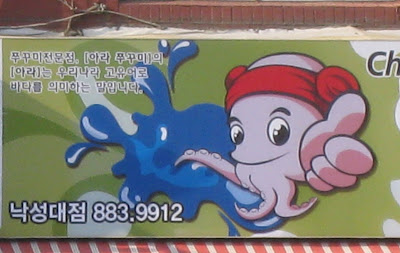
Our friend the jjukkumi 쭈꾸미, a tiny species of octopus sometimes eaten live, marries a playful wink to his thumbs-up.


Of course, that's not actually a thumb, but a skillfully manipulated--oops, I mean tenticulated!-- tentacular pseudo-thumb.


Below is another jjukkumi restaurant going for a different feel. These thumbs-up octopuses are dynamic, athletic dudes just back from, or about to head off on, an action-packed adventure.


The pig below looks too punch-drunk to realize he's about to be devoured.


The Chinese character on his cap means 'suckling pig'. (It's pronounced ton とん in Japanese and is the first syllable of tonkatsu, Japanese fried pork cutlets.)

[The paragraph below updated May 5, 2008 thanks to Seonsaengnim.]
How about this traditionally-dressed nobleman silkworm, slurping up the bed of greens on which he's being served? He's pretty good with the chopsticks. (Based on the name of the restaurant, Ppungnip Sarang 뿡잎사랑 "Mulberry Leaf Love", and on the gustatory habits of silkworms, the greens must be mulberry leaves. I've eaten here. They serve spicy hot-pot with lots of vegetables, but I don't think humans eat mulberry leaves. And as far as I know silkworms aren't on the menu either, though fried up they are a snack commonly sold by street vendors. So this bit of anthropomorphy may not be directly related to the food sold by the restaurant.)


But getting back to baby octopuses, here's a restaurant that serves both grilled meat and jjukkumi. The sign hits two themes, with a plate of grilled baby octopuses on the right, and a masked snorkeling cartoon octopus on the left. [This paragraph corrected May 5, 2008, thanks to Seonsaengnim.]


The octopus is wearing one glove and shoes, and sports a Dragon Ball Z-type Japanese anime haircut.


There really are a lot of octopuses, aren't there? I've never had jjukkumi myself. The restaurant on the left below has Japanese-style takoyaki -- fried octopus balls.


He's got the glove, the thumbs-up, the Japanese chef's hat-band ... and a delicious steaming-hot fried octopus ball about to suffer a cannibalistic fate, as we can infer from the anticipatory lip-licking.


We'll return to the other sign in the above photograph later. But first, can somebody tell me what's happening in the picture below?


The pig, apparently named Dr. (as in Ph.D.) Go, is wearing an angry octopus bonnet. But despite the distress of the octopus struggling atop his head, Dr. Go seems to be stifling a yawn--or is it a giggle?

While we are on the subject of opaquely behaving anthropomorphized pigs:


I must confess: this is a cultural reference that escapes me. I believe that behind the pig's head is the flaming grill-plate on which she is being serenely cooked. But why is she wearing a Fred-Flintstone-type skirt and holding some sort of stone tool? Is she a refugee from the stone age? Maybe back then, when pigs were killed, skinned, and cut up with stone axes, they tasted more delicious.

From serene we move to downright Dionysian porcine behavior:


This pig, wearing a chef's hat and gloves, is having the time of its life as it prepares to be steamed inside a bamboo tube. The large glass of red wine can't be hurting.


Enough pigs. Let's get back to the fellow I skipped earlier:


Yes, he's a gimbap. Sticking out from his dried-seaweed enclosed body are some spinach, some yellow pickled daikon, orange carrot, and pink processed meat. Actual gimbap looks like this:


My favorite gimbap sign is the one on the shop around the corner from where I live.

Yes, I'm thinking the same thing you are. Why is that gimbap wearing a bandana?


[The following two pictures were added May 4, 2008, 9:35 pm:]


This cow is one of the least anthropomorphized animals I've seen on a sign. Yet there's something irresistible about his big snorty toothy guffaw.


Maybe part of the appeal is the way his cowbell dangles nonchalantly outside the bounds of the circle.


This picture doesn't strictly fit the theme, but it's so doggone cute I just can't not put it in here.

These two little South-Parky kids seems to be wearing their bowls of noodles upside-down on their heads, and they couldn't be happier about it. The one on the left is holding a big slice of pickled daikon, but I don't know what's in the box the other kid is holding. There appear to be chopsticks sticking up behind one of the bowls, and maybe a squid behind the other?

The wording beneath them says "Wanna eat ... wanna wrap and go ..." (??).

Anthropomorphism isn't strictly limited to edibles. This is a computer shop:


I can't quite figure out why this fellow seems so likable, when he has no facial features at all. Maybe it's the energetic angle at which he is grasping his umbrella, or the careless insouciance with which he disregards the hatband dangling in front of his face.

Friday, May 2, 2008

Nam-Buk Han

Today in class our teacher mentioned that the Korean war (1950-1953) is not actually over. Most of the students were astonished to hear this; they were not aware that hostilities ended on July 27, 1953 with the signing of a ceasefire, not a peace treaty.

Indeed, the situation here on the Korean peninsula is bizarre by any measure. Perhaps one of the most bizarre things of all is that life in South Korea is now so normal, despite the fact that the capital city lies only 30 miles from a highly militarized, delusional, dictatorial state that is technically at war with the South and has over 1.2 million men under arms.

Most of the time one is hardly aware of this state of affairs. It is forcefully brought home if one visits the DMZ (the demilitarized zone separating North and South Korea, 휴전선 休戰線). And in certain areas one sees a heavy military presence and defensive fortifications, like the ones I described in a recent post. But generally speaking this does not feel like a militarized society, or one that is concerned about the possibility of war. No one worries that living in Seoul is dangerous because of its proximity to the border, as the housing prices here will attest. One can travel the country freely, without showing ID or being stopped at military checkpoints. I only occasionally see young men in military uniform, and never in large groups.

It wasn't always like this. One of our teachers recently described what things were like in her childhood in the 1970s, when South Korea was still essentially under military dictatorship (under strongman Park Chung-hee 발정희 朴正熙, who ruled from 1961 to 1979). The anti-North Korean government propaganda machine was in full flower. Our teacher said that she truly believed that North Korean leader Kim Il-sung 김일성 金日成 had the face of a pig, as he was always depicted that way. She used to have nightmares about being attacked by wolves, which is how the North Korean soldiers were described.

She also said that mini-skirts shorter than a certain length were illegal, as was long hair on men. The police used to walk around with rulers, which they would whip out in order to measure skirt and hair length. Offending women would be arrested, offending men given an instant haircut on the street. In addition to the usual lack of political freedoms found in any dictatorship, South Korean civil society was itself highly militarized. Men were expected to look like soldiers.

To me, from the perspective of life in South Korea today, this all seems paranoid and ridiculous. (Though I don't mean to downplay the real possibility of a North Korean attack on South Korea at that time.) But I imagine that living through it must have been no joke. So what's surprising to me is that the teacher described all these recollections with great amusement; far from being bitter about the experiences, she seems to view them from a detached and comfortable perspective.

I am deeply impressed by the way that, since the late 1980s, the Koreans have peacefully transformed their society from a repressive military dictatorship into a free, open, and prosperous democracy. This has happened in Taiwan as well, but it's especially impressive here because it all happened under the unchanging shadow of the proximate North Korean threat. (The collapse of the Soviet Union, the major supporter of North Korea, certainly helped make it easier to change the political climate. And it should also be pointed out that mandatory universal military service for men is still the law here.)

All that being said, the utter absurdity of the political situation on the peninsula does occasionally leak through into daily life here in subtle but jarring ways.

Here's a simple example. A few weeks ago I decided to buy a large map of Korea to hang on the bare wall above my bed. I wanted one of the whole peninsula, both North and South. At the bookstore I found the map section; the folded maps were on a bookshelf, stored in cardboard envelopes which had the map titles printed on their spines. I kept seeing maps that said "Republic of Korea 대한민국 大韓民國", which is the official name of South Korea. (North Korea is the "Democratic People's Republic of Korea 조선민주주의인민공화국 朝鮮民主主義人民共和國". )But nothing was labeled in such a way to indicate a map of the whole peninsula, and I didn't want to buy one of just South Korea. Eventually, I opened one of these South Korean maps to see what it would look like, and realized that it was in fact a map of the entire peninsula. (I now suspect that it's not possible to buy a map of just South Korea, any more than you could buy a map of the southern half of the United States.)

Here's what my room looks like with the map up. As you can see, I've also put up some pictures of me and Erma from London, Venice, and Hong Kong.


If you are so inclined, you can compare the picture above with ones taken soon after I moved in, on this post.


So here's what the map looks like. It shows the peninsula as a single, undivided country, labeled "Republic of Korea". But surely, I thought, this map can't really be as delusional as it appears. The existence of North Korea must be acknowledged somewhere?


There are in fact two clues to the existence of North Korea on the map, but they take a practiced eye and a bit of interpretation to spot and understand. One is the small inset map on the lower left in the picture above, just above the map legend. It's labeled "Pre-1949 administrative units of the north Korean area". (The Korean alphabet lacks an equivalent distinction to upper vs. lower case, and there is no conventional way of signaling proper nouns in the orthography. I've chosen to translate the Korean phrase 북한지역 as "north Korean area" rather than "North Korean area" -- the difference is important. But I'm not sure if this aspect of my translation is correct.)

The other clue is a small dotted red line that runs across the center of the map. It cuts clean through the middle of Gangwon Province (on the east side, in green). In the image below, I've marked the beginning and end of the dotted line with arrows.


I've also highlighted Seoul and labeled Ganghwa Island, which I talked about here.

Although the dotted red line is clearly the boundary line between North and South Korea -- or, more technically, the armistice line -- it is neither labeled on the map nor identified in the legend.

In other words, this map -- and all others that I've seen here -- presents the illusion of a unified Korean peninsula under the government of the Republic of Korea. This strikes me as absolutely bizarre, as well as pointless. Is this meant as propaganda -- if so, who is being fooled by it? Or is it an expression of the citizenship's idealized hope for a reunified peninsula?

I wonder what maps of Korea in North Korea look like.

I tried to find some propaganda posters on the web depicting Kim Il-sung as a pig and his soldiers as wolves, but no such luck. The most interesting South Korean propaganda poster I could find was this one:

It's labeled "Communist Aggression" and depicts Russia (oddly not "The Soviet Union") as the force ultimately behind the aggression of the North Korean foot soldier, who looks to me like a somewhat sympathetic pawn in this image. I don't know anything about the provenance of the poster.

Thursday, May 1, 2008

Sogogi

I'm sure all of you followed the details of Korean President Lee Myung-Bak's visit to the US. Am I right?

So you probably know that one result of the visit was that President Lee agreed to reopen Korea's markets to the importation of American beef, despite concerns about mad cow disease. This was after Bush made Lee eat a steak.

Reading this news presented me with a bit of a conundrum. For some years now Erma and I have not been eating American beef, unless we are fairly confident that it is organic, natural, or otherwise not being fed ground up brains of other mammals. This is because of our suspicion that the beef supply isn't really safe in the US -- a suspicion that seems to be confirmed every few months by news of an infected cow or of unsanitary practices at slaughterhouses.

Thankfully, it looks like American beef imports into Korea won't begin until I'm safely home and within striking distance of a Whole Foods.

As it happens, the beef import issue came up in class on two different occasions last week, offering me two different Korean perspectives. The first teacher who mentioned it said that Korean were mostly pleased. They didn't want to eat the American beef, of course, but its presence on the market would hopefully drive down the prices of Korean and Australian beef, helping the average consumer. It was the meat industry people, said the teacher, who opposed the importation, since it would drive down prices and profits. And, of course, Koreans could still make sure to buy Australian or Korean beef at the markets. (Students eating at cheap restaurants would not have the luxury of selecting the source of their beef, though.)

We have three different teachers, who come on different days of the week. The second teacher also raised the issue. She said most Koreans were opposed. They feared that even if they bought Korean or Australian beef, it might be sliced up with a knife that had touched American beef. In short, there was no way to defend oneself against the possibility of infection by mad cow disease. (Not eating beef would probably never occur to most Koreans as an option.)

She said something else interesting. Most Koreans believe that Korean beef is of exceptionally high quality, and those who can afford it are willing to pay almost twice as much for it. But this teacher said that her husband suspects that Korean beef really isn't so great. Why? Because the Japanese, who are famously discerning in their beef choices, don't eat it. So he only eats Australian beef!

From what I can tell looking at the news media, the second teacher seems to be right: most Koreans are not pleased with the concessions made by President Lee. See, for example, this recent news item.

Ganghwado

This past Sunday I went to Gwanghwa Island. I was taken by the husband of a friend, a Korean woman who I met in graduate school. The island is located at the mouth of the Han River, near Incheon, and is an important historical and cultural site.

It was a cold and drizzly morning, which meant fewer recreation seekers and little traffic, so we were able to get there from Seoul in about an hour. The drive, along the banks of the Han River (한강 漢江), was interesting. For several miles there is barbed wire stretched across the south bank of the river, where the river marks the boundary line with North Korea. Inside the barbed wire there are numerous military guardhouses. Some of them looked unused, but some were manned by South Korean soldiers. I don't know if security has always been tight in this area, given the proximity to the North Korean border, or if an incident that occurred in March 1980, when three North Koreans attempted to infiltrate South Korea by crossing the river here, is partly responsible.

I managed to get only one blurry picture of a guardhouse from the moving car. I believe that in this view we are looking east, on a stretch of the river that runs north-south, so the opposite shore is not North Korea.


On the island we stopped first at a small fort, which is now a park with a historical museum. Because of its location at the estuary of the Han River, the island was an important defensive location, as it protected river access to the capital. It also served as a refuge for the royal court during times of land invasion. The island therefore played important roles over the last 1000 years during attacks by the Mongols, Japanese, Manchus, French, and Americans. Korea won some of those battles and lost others. The American marines soundly defeated Korean forces there in 1871, as part of an attempt to force Korea to open itself to trade. It was a short and lop-sided battle: about 350 Koreans were killed, while only 3 Americans died. You can read details here. Recently, America agreed to lease back to Korea the large battle flag that was captured during the battle.

Here's a picture of the flag:

Flowers were in full bloom on the grounds.


There are still plenty of old cannons around. I was reminded a little bit of the forts at Quebec, although the cannons here are much smaller.

That's the history museum in the background of this picture:


We next stopped at the local fish market for lunch. This was the kind of place, and the kind of food, that seemed likely to cause serious digestive ailments for a visitor. But I couldn't pass up the chance to have local, fresh seafood.

We got grilled shellfish. This astonishing dish arrived at our table:


We laid the shells over a charcoal grill to cook them. (This picture is worth clicking on and inspecting in detail.)


Our next and final stop was the famous Jeondeung Buddhist Temple (전등사 傳燈寺), said to have been established in the 4th century. It's set in a lovely U-shaped plateau nestled in the mountains in the south part of the island. The balloons are in celebration of the Buddha's birthday, a national holiday on March 12. The weather had cleared up nicely by afternoon.


Korean Buddhist temples often have a pavilion with bell, a drum, a fish, and cloud plate, all of which are sounded at certain times of day for various purposes, both mundane and spiritual.

In this shot you can see the bell (범종 梵鍾) and drum (법고 法鼓); the cloud plate (운판雲板) is hanging behind the bell.


And here's the wooden fish (목어 木魚 or 木漁).

I found three things on the island that connected to other experiences I've had here in Korea. First, there was a lot of information at the historical museum on movable type, which apparently was invented and developed on the island (hundreds of years before Guttenberg). I'd been learning about that in my philology seminar.

Second, the Tripitika Koreana, which I saw at Heinsa Temple, was carved on the island, while the Goryeo court was taking refuge there from the Mongol Invasion. Actually they were carved twice, as the first set was destroyed by the Mongols. The second set set was later moved to Heinsa.

Third, a branch repository of Kyujanggak, the royal library, was located at Jeondeung Temple. The building is still there, though it is empty now, as all its former contents are either in France, having been stolen by the French, or at SNU.

It was really satisfying for me to see all this historical and material connections, and link together various strands of my sojourn here.