Sunday, June 28, 2015

Bohemian Gyeongju

Gyeongju was for a millennium the capital city of the kingdom of Silla, which ruled all of the Korean peninsula from the 7th through 10th centuries. While the legacy of its regal past is everywhere in evidence in the form of the many massive burial mounds scattered in and around the city, and is on display at the fantastic Gyeongju National Museum, nowadays it is a small, unassuming city. It has no skyline to speak of, and thrives mainly on tourism. There is here none of the modern-day urban bustle of Seoul, the megalopolis capital of South Korea.

But there is a kind of romantic luster limning Gyeongju that seems to attract a certain type of outsider. Artists, calligraphers, history buffs, counter-culturalists, drop-outs, and iconoclasts have come here to settle. All over town there are signs in Chinese characters, propped up against dilapidated buildings in out-of-the-way narrow alleys, announcing the presence of a "Three Kingdoms History Research Study Group" or an "Ancient Calligraphy Studio".

Many of these folks seem to end up opening restaurants, which function as expressions of their artistic sensibilities or as gathering places for their like-minded friends.

So it's not unusual to find restaurants whose walls are decorated with classical poetry and whose bookshelves are lined with volumes on history and archeology. In the evenings there are little salons where conversation, lubricated by soju, lingers long into the night.

The poems below were on the wall of a loach-soup place we went to months ago. The presentation isn't anything special, just computer printouts, but this is the sort of thing that can appeal only to a small subset of the population. (Bear in mind that most Koreans can no longer read Chinese characters, let alone poems written in Classical Chinese.)


We recently ate lunch on the site of the former school of the Chinese-Korean community of Gyeongju. It was purchased by a middle-aged man who opened a small artsy printing studio and grilled kalbi restaurant on the grounds.

The printing studio, Wol In Jae 月印齋

The plaque for the Chinese-Korean school still stands outside the gate.


Inside the walls were decorated with all sorts of artistic photographs, ranging from landscape scenes to candid portraits.
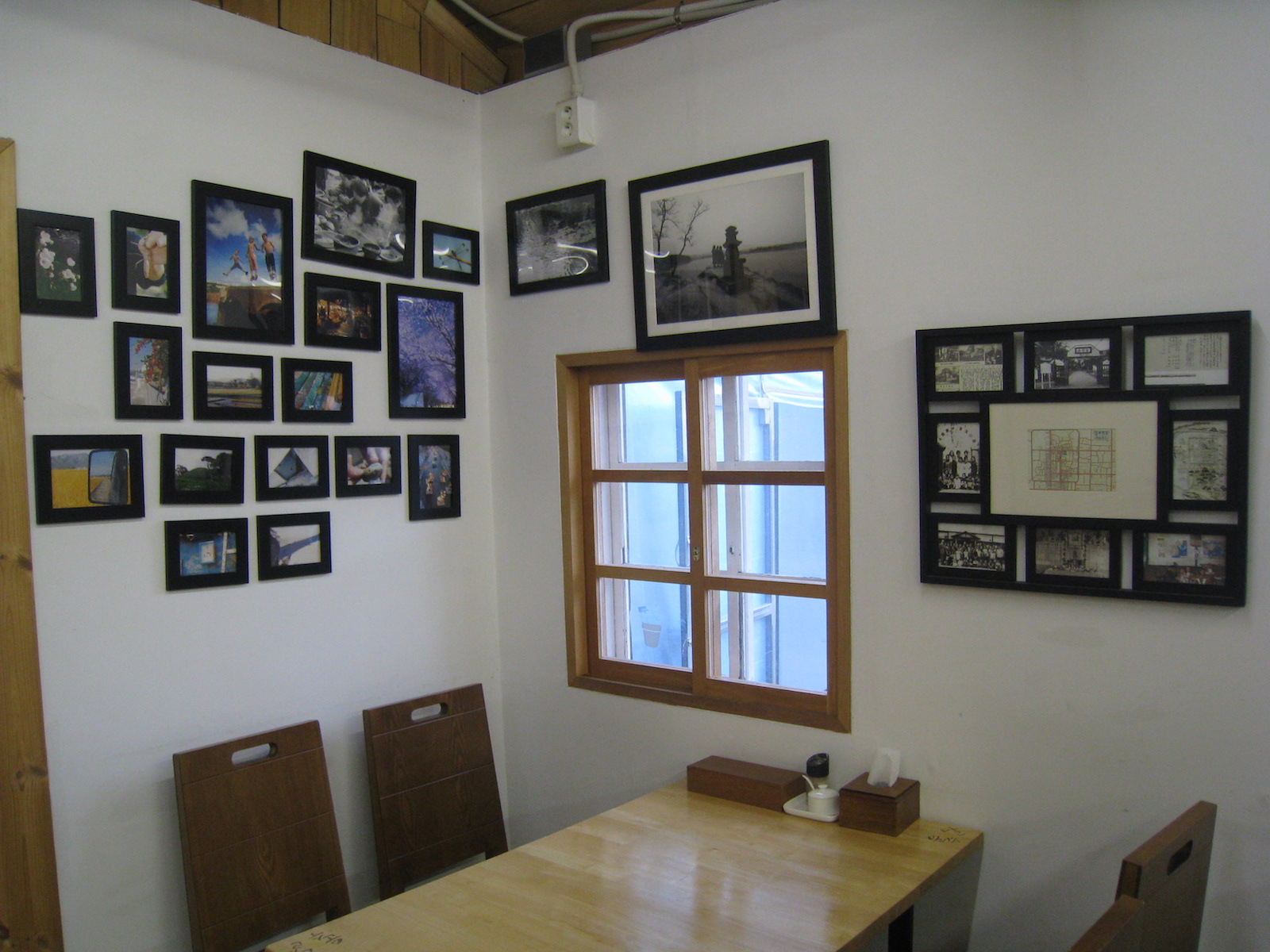

But the pictures that struck our eyes were the 9 in the frame on the right of the above picture, shown again below:


These are all 20th-century scenes related to the Chinese-Korean school when it was in operation. On the lower right you can see a map of China on the classroom wall, and in the lower center photo are portraits of Sun Yat-sen and Chiang Kai-shek.

We didn't know anything about the place, but a young man—who turned out to be the owner—a little drunk from some lunchtime revelry with friends, wandered over to talk to us. "You are the first customers to ever notice these photos," he said. He sat down to tell us about them. He and Erma's mother chatted for a while about local history and his own history.

If you are a big-city person, Gyeongju isn't the place for you. But if you think you weren't meant for the modern era, consider opening a restaurant here and discovering a small circle of like-minded Bohemians.

Saturday, June 27, 2015

Does this video convey how scary the streets are here?

I keep trying to take video to illustrate how terrifying the traffic and driving culture is in Gyeongju. But nothing seems to accurately convey the feeling of actually being here. The video below is the best I've gotten so far.

It also has the advantage of including a fruit truck. These trucks are pretty common in the city; they drive around, parking at busy intersections or in front of wholesalers. They have loud recorded looped messages advertising their wares. (I use fruit truck in a generic sense; produce is by far the most common item sold off trucks in this way, but it is not the only one.)

There are a few things to note in this video. First is the lack of sidewalks; there are only narrow strips at the side of the road, marked off by a yellow line. Even this narrow walkway is frequently blocked by obstacles, forcing pedestrians to walk into the street with alarming frequency. (Korean pedestrians are completely unconcerned about this, as far as I can tell.)

Second is the completely unregulated intersection. Notice the way cars just slide into it, barely slowing down. There are some large mirrors mounted on poles so you can see traffic coming from the sides, but the visibility is still really poor. Cyclists glide into this intersection as recklessly as cars do.

Third is the cyclist, a topic I wrote on in the previous post.

To view higher-quality video on Vimeo, click me and enter password "korea".

The video was filmed along the route I walk with Tek every morning to take him to school. I no longer find that a heart-stopping experience, which just goes to show that a person can get used to just about anything.

Friday, June 26, 2015

Bicycles in Gyeongju

Gyeongju is a bike city. By that I don't mean that it is particularly friendly to bicycles. In fact, I'd be terrified to ride a bicycle here. But it seems that just about everyone rides a bicycle as a matter of course. It's a ubiquitous and unremarkable form of transportation.

In my American experience, people who ride bicycles are "marked" in some way. They do it for fitness, or recreation, or to make a point about the environment or about urban planning. It's hard to be a regular bike commuter in the US (which I am) without feeling like you're a bit iconoclastic. Certainly others will see you that way.

Not that there isn't recreational biking in Gyeongju. But that's mainly for tourists. Around the Bomun Lake resort area there are lots of bicycle rental shops. Korean and foreign tourists are among their patrons.

But it doesn't take long to realize that the vast majority of Gyeongju residents aren't biking for their health or for sport. Remember this picture of the riverside from an earlier post?


There is a dedicated pedestrian lane, in-line skate line, and bicycle lane. This is on a warm weekend afternoon in April. Where is everybody? (Answer: hiking.)

If you want to find all the cyclists, just walk on the city streets. Young and old, male and female, rain or shine, all on bikes.

First a whole lot of pictures (all taken on a two-block stretch near where we live), then some more commentary. You might notice some familiar faces on the margins of some of the pictures.


I find this intersection terrifying, whether I'm walking or driving. I would not want to bike through it.


A few things to notice:
  • No helmets. Never seen one.
  • Quite elderly, even frail people ride bikes.
  • This may resemble Holland in its flatness (ignoring the mountains ringing the city) and in the ordinariness of bicycle commuting, but it is certainly not Holland in terms of bicycle infrastructure. There is nothing in the way of protected or dedicated lanes or signals. Cyclists are pretty much always weaving in and out of traffic.
  • The masks are an ordinary thing in Korea (this has nothing to do with MERS). People wear them to keep out dust, as a courtesy if they have a cold, or if for whatever reason they are worried about getting sick. At all times of year it's normal to see people in face masks around the city.
  • Notice how many women are wearing enormous visors? This is what a lot of women, especially middle-aged women, wear for sun protection. (When hiking too.) Erma has been considering getting a visor on this trip, now that she too is an "ajumma".
  • The bikes are simple and practical, not built for speed or style. They are sturdy and most have baskets.
In a way, it seems a bit funny to point out how "amazing" it is that all kinds of people ride bikes here. Erma said to me, "It's like saying 'Look at how many different kinds of people drive cars in America. Young, middle aged, even seniors!"

Modified bicycles are not uncommon. Here's an adult bike with "training wheels", though whether it's because the rider has become too old to balance well, or whether it's because she never learned to ride a two-wheeler, is not clear.


Here is one of the bicycle racks in our apartment complex. Just about everybody seems to own a bike.


There aren't a lot of bicycle racks around town, but neither are they rare. Most are non-descript, but these swoopy colorful ones struck Erma's eye on a walk a few weeks ago:


Thursday, June 25, 2015

How do Koreans pronounced "iPhone 6"?

A normal person might attempt to answer this question by asking some Korean people. But we can take a less direct and more nerdy approach and try to puzzle it out.

First, some necessary background. (Stick with it, there's a payoff at the end.)

There are two sets of numbers in regular use in Korean. One set is the native Korean numbers that have been in the language for thousands of years. The native numbers from one to ten are:

  1. hana
  2. dul
  3. set
  4. net
  5. daseot
  6. yeoseot
  7. ilgop
  8. yeodeol
  9. ahop
  10. yeol

The other set is the so-called Sino-Korean numbers, which were borrowed from Chinese around 1500 years ago. They are:

  1. il
  2. i
  3. sam
  4. sa
  5. o
  6. yuk
  7. chil
  8. pal
  9. gu
  10. sip

Both are in common use, but usually only one set is used in a given context. For example, when telling time, the native Korean numbers are used for the hour and the Sino-Korean numbers are used for the minute. So "6:06" is:

yeoseot-si yuk-bun
'six-hour six-minute'

As in the example just given, whenever a Korean sees the written Arabic numeral "6", he or she will determine from context whether it represents native Korean yeoseot or Sino-Korean yuk.

6일 can only be yuk-il 'sixth day (of the month)'
6명 can only be yeoseot-myeong 'six people'

So that's the necessary background. Now we're ready to solve the mystery of "iPhone 6".

On a recent trip to Seoul, Erma and I noticed a billboard for the iPhone 6, visible from the train window just a few minutes outside of Seoul Station:

It's the square white billboard on the right. Click through to see a larger version of the picture. Or just look at the photo detail below.
Here's a close-up of the billboard, with the text transcribed in the caption to the photo:

"iPhone 6로 찍다"
The billboard says "Take photos with the iPhone 6". But how is that "6" pronounced? Erma and I wondered. Is it yeoseot or yuk? Neither of us are native speakers of Korean and we have no feel for what would be appropriate here.

But a moment's linguistic analysis yielded a surprising result: the answer is neither.

"iPhone 6" is followed by a Korean grammatical word, ro 로, which means 'with'. (Unlike English with, which as a preposition precedes a noun, this Korean word is a postposition which follows a noun.) The word ro is a bit like the English indefinite article a/an. The indefinite article has two forms: one precedes a consonant sound, and one precedes a vowel sound (e.g. a book, an apple). The Korean word also has two forms: ro follows a vowel and euro follows a consonant.

What this tells us is that "6" here represents a word that ends in a vowel. But neither yeoseot nor yuk ends in a vowel!

There's only one remaining possibility, and in Sherlockian fashion, we have no choice but to accept it. The word represented by "6" is the English word six.

"Oh-ho!" you say, Watson-like: "But six too ends in a consonant!"

"Quite so, my dear Mr. Watson. But you have overlooked one crucial fact. This is not the English word six as pronounced by Englishmen such as ourselves, but as pronounced in its borrowed form by people of Chosŏn."

That borrowed form is sikseu (pronounced something like sik-suh), which does indeed end in a vowel, and thus must be followed by ro, not euro.

So the answer to the question that forms the title of this post is: aipon sikeuseu. And we didn't have to ask any Koreans to figure it out!

Sunday, June 21, 2015

Hiking culture in Korea

Hiking is the Korean national pastime. Korea is famously mountainous, and its people have a long-standing, intimate connection with mountains.

When the weather is nice, Koreans go hiking. On summer weekend mornings, the Seoul subway cars are crowded with recreational hikers heading out to trails on the outskirts of the city. Here in Gyeongju, famous mountain trails attract locals and tourists alike.

There is also deeply embedded cultural knowledge that exercise is vital to the health of the elderly. Old people are constantly exercising. Whether they are using the adult exercise stations that are in public parks, or taking daily constitutionals, or hiking up mountains, it's not uncommon to see men and women in their 60s, 70s, and 80s engaged in vigorous outdoor activity.

An exercise station along the Gyeongju riverside.
Woman hula hooping (with GIANT hoop) at exercise station near top of Songhwa-san trail.

So it's not uncommon when out hiking to meet elderly people along the trail. Many are in excellent health, and (like Erma's parents) can move as quickly and surely up and down the trails as people half their age. Others are clearly weak and frail, and make themselves move by sheer force of will. I remember once a few months ago walking up a trail at Songhwasan and coming across an elderly woman leaning against a tree, resting. She was methodically pounding her arm and leg muscles with her fist, trying to beat out the aches and pains. "Ay," she moaned, "this is so hard!" But she knew she had to keep going, and later while we were resting and having a snack at a higher point on the mountain, she came into view, shuffling with dogged purpose.

****

Korea is a prosperous country. Koreans are also style-conscious, so it is perhaps no surprise that a good deal of their disposable income seems to go toward hiking gear. Even on easy, short, level hikes, many Koreans are dressed in outrageously fancy gear. They are covered head to toe against the sun, with elaborate hats, hiking poles, and fashionable outdoor wear in an array of shiny bright colors. Here are a few surreptitious photos we've managed to take of hikers decked out in typical fashion.


This is by no means an original observation. The NPR reporter stationed in South Korea recently tweeted about it.
And these hiking outfits aren't just worn for hiking; they have become fashionable in and of themselves, so you see them worn as leisure and travel wear as well. Perhaps one could draw an analogy with yoga pants in the US: specialized exercise gear that crosses over into everyday fashion wear.


Koreans are also meticulous about keeping their clothing (and the inside of their cars) clean. At the bottom of the main Namsan trail there is a small compressed-air station that hikers use to blow all the dirt and dust off their clothes and shoes at the end of hike. If an amenity like this isn't available, Koreans will use compressed air (for filling tires) at a gas station.

This video shows some hikers cleaning up at Namsan. I was goggle-eyed when I first saw this: there is something almost surreal about it, at least from my blinkered American perspective. (As always, it's better to bypass the terrible video quality on Blogger and click through to the Vimeo version.)


To view higher-quality video on Vimeo, click me and enter password "korea".

Saturday, June 20, 2015

Paying bills by bank machine

Back in February I wrote a post on how easy it is to transfer money to another person's bank account. It turns out it's also really convenient to pay bills at specialized bank machines.

There seem to actually be an enormous number of ways to pay a bill. Here is the latest electric bill for the studio apartment that Erma and I rent as an office.

Two things to note. On the middle right, there is a red box within which are account numbers at all the major banks in Korea. You can transfer money to any one of these accounts to pay your bill. Presumably this is something you would arrange in person at a bank or on line. The account transfer method by ATM shown in my earlier post wouldn't work, because there is no way to provide the billing account number.

The bottom third of the bill is the detachable section that you would send in if paying your bill by mail. It also has a 2D scannable code on the lower right.

It's that 2D code that is read by the specialized ATM machines used for paying bills.

Here's the opening screen of the ATM. (It looks weird because I've stitched together two separate photographs.)


We were initially baffled by this screen. None of the options seemed to obviously fit our bill. Several of them are for paying local taxes. One, on the upper right, if for "apartment management fees".

The first time Erma and I wanted to pay a bill this way, the bank assistant came out and helped us do it. But we failed to pay attention to which button she selected. The next time we tried to pay, we just couldn't figure it out. So we took some pictures and brought them home to check against a dictionary and ask Erma's parents.

The button at the upper left says "jiro 지로". My on-line Korean-English dictionary translates as "electronic billing system, (Brit) giro". Turns out that according to this Wikipedia entry, giro is an electronic payment system primarily used in Europe, and the name derives from the Italian giro 'circulation of money'.

Anyway, it turns out that that button—"giro utility bill payment"—is the right one. Check out the video below to see how the payment process works. (Better yet, click through to the higher quality version on Vimeo.)


To view higher-quality video on Vimeo, click me and enter password "korea".


Friday, June 19, 2015

Thatched roofs

In the old days, the roofs of traditional Korean houses were thatched with straw. You don't see many thatched roofs these days, but we spotted one today downtown, tucked between some modern buildings.